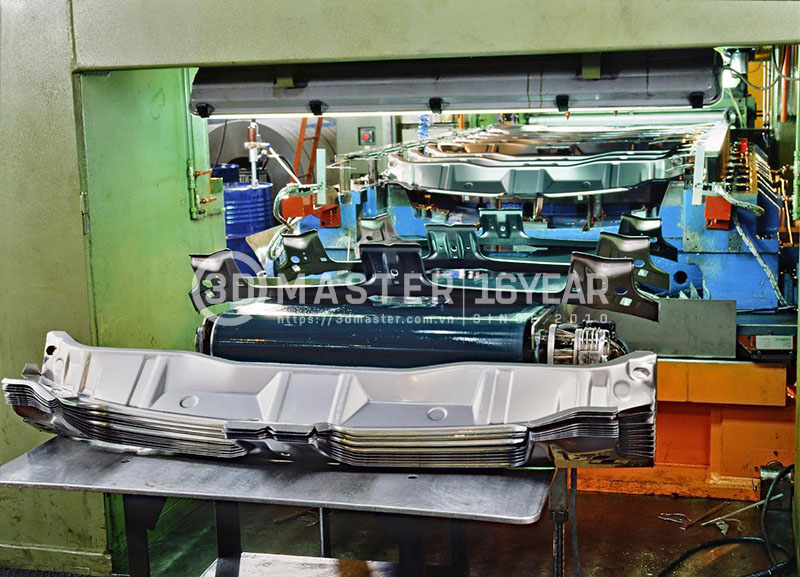
In the automotive industry, body components are manufactured using sheet metal stamping technology. These parts are produced separately and go through multiple stamping stages before being welded together into the final assembly. So, how can manufacturers ensure that separately produced parts fit precisely into a complete vehicle body?
Depending on the complexity of the automotive part, stamping can be performed in a single operation (each press stroke creates the desired shape) or through multiple high-speed sequential operations.
Due to unpredictable factors such as springback during stamping, how can manufacturers ensure that parts formed at high production speeds still fit accurately during final assembly?
Typically, quality control is performed by inspecting the first part of a production run (first-off inspection) and the last part of the run (last-off inspection). These activities generate a large volume of parts that need to be inspected.
To achieve optimal productivity, the automotive industry needs to measure all these parts. However, performing this on coordinate measuring machines (CMM)—traditional metrology equipment with long programming times and slow operation—is inefficient.
Therefore, the key question is: how can manufacturers improve productivity and enhance quality control to inspect more parts and increase production throughput (the number of parts released for final assembly)?
There are multiple ways to inspect stamped automotive parts. Checking fixtures can be used, where parts are positioned to inspect trim edges and hole presence or diameter. However, this method does not provide full information about overall geometry or hole positioning.
To overcome this limitation, CMM operators must run either long programs (measuring all features) or short programs (focusing on critical tolerances or recently deviated features).
Metrology teams must handle multiple inspection programs simultaneously. When a quality issue is detected, alerts are triggered, and root cause investigations take priority.
During this investigation period, first-off and last-off inspections may be delayed. The question is: can productivity and flexibility be increased to handle urgent situations without disrupting standard inspection schedules required by customers?
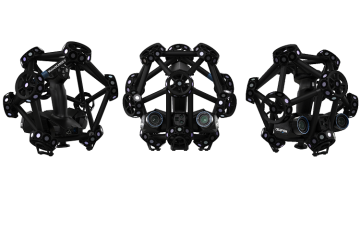
Automated 3D scanning is a solution that increases productivity and synchronizes quality control with the production pace of the automotive industry. One of the most effective approaches is the use of automated robotic metrology cells such as CUBE-R.
However, the transition from traditional first/last inspection on CMM systems to automated 3D scanning can be implemented gradually. The first step is to apply measurement technology directly on the shop floor.
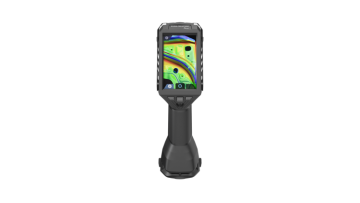
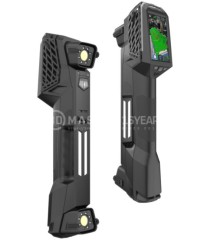
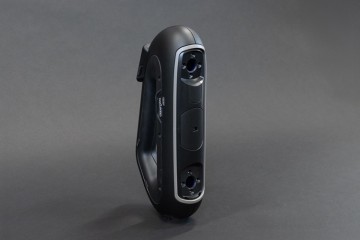
Using automated 3D scanning instead of contact probing enables the collection of significantly more data in less time. Portable 3D scanners such as HandySCAN 3D or MetraSCAN 3D are prime examples of easy-to-use solutions.
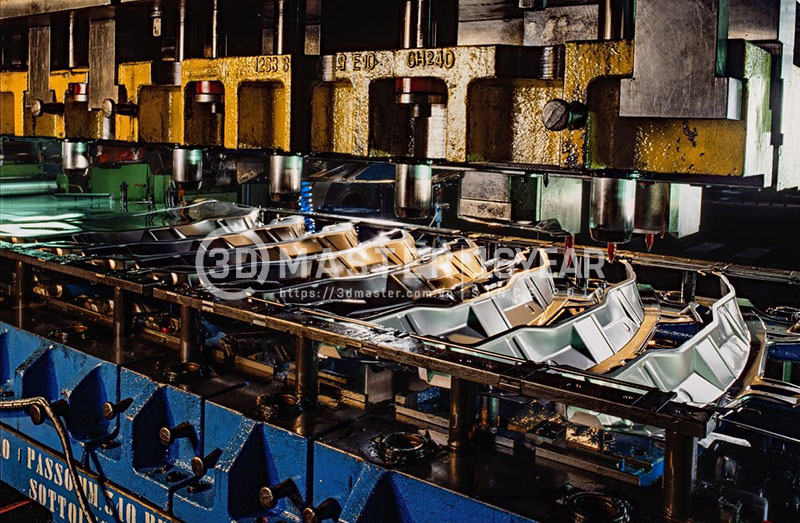
The use of portable automated 3D scanning technology allows faster inspections with richer datasets covering the entire surface of automotive parts. The time saved can be used to:
In summary, thanks to its mobility, speed, efficiency, and accuracy, portable 3D scanning technology significantly boosts production productivity.
In the future, systems may enable 100% inspection directly on the production line. In the meantime, adopting this technology helps manufacturers proactively detect issues and eliminate emergency situations.
In Vietnam, 3D MASTER is an official distributor of Creaform with over 10 years of experience in deploying 3D metrology solutions for industrial applications. Rather than simply supplying equipment, 3D MASTER positions itself as a technical partner, supporting businesses in building measurement processes tailored to specific production challenges.
With a full demo system including HandySCAN and MetraSCAN, along with a team of highly skilled engineers, 3D MASTER is capable of conducting on-site evaluations, live demonstrations, and providing optimized solutions from assessment to real-world implementation—helping businesses bridge the gap between technology and operational efficiency.
CONTACT
Hotline - Zalo - LINE - Telegram - WhatsApp - Viber - Kakaotalk: +84 982 089 198 | 0986333960
Email: cuong3dmaster@gmail.com | hung3dmaster@gmail.com | tech3dmaster@gmail.com
Website: https://3dmaster.com.vn