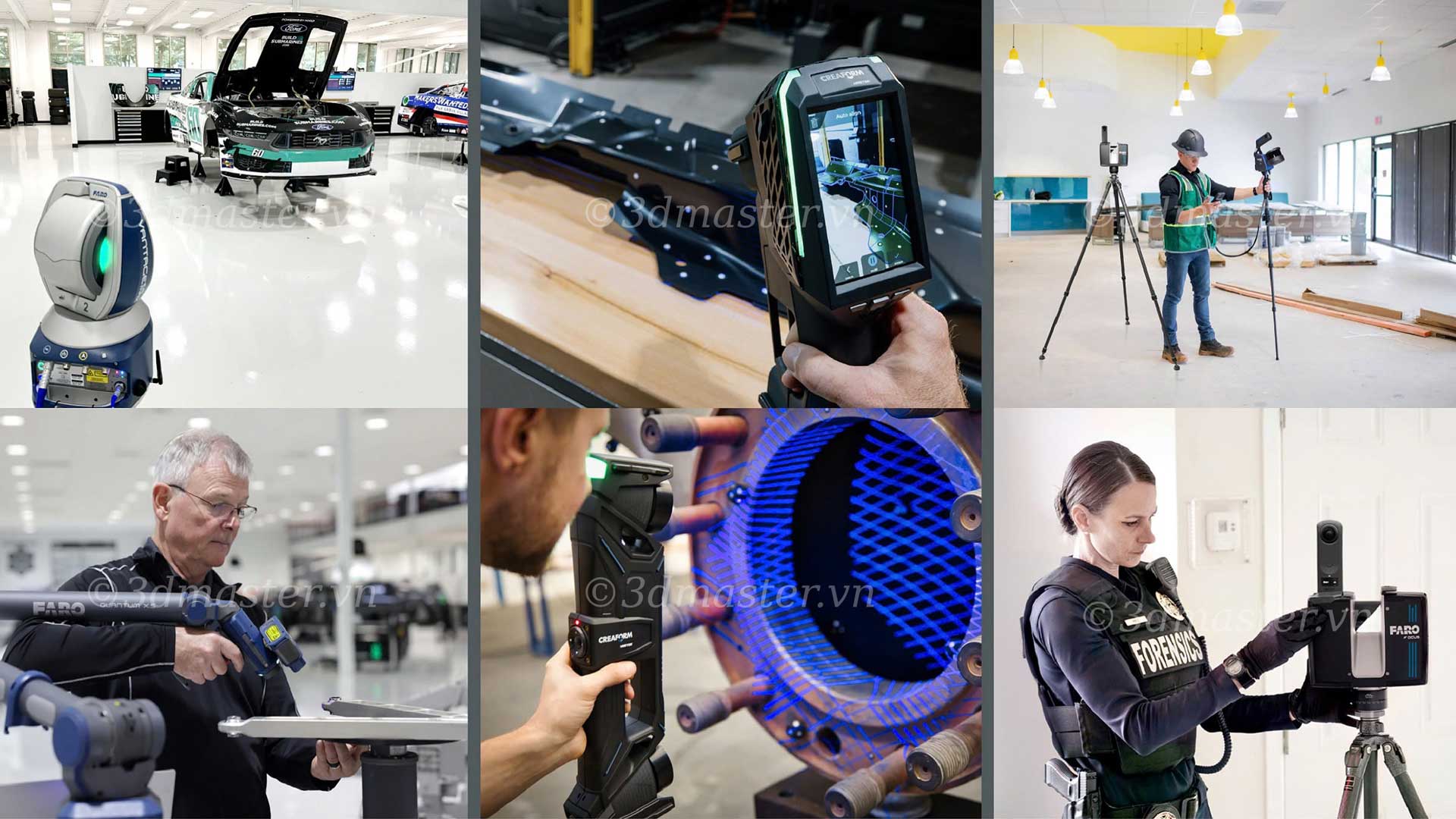
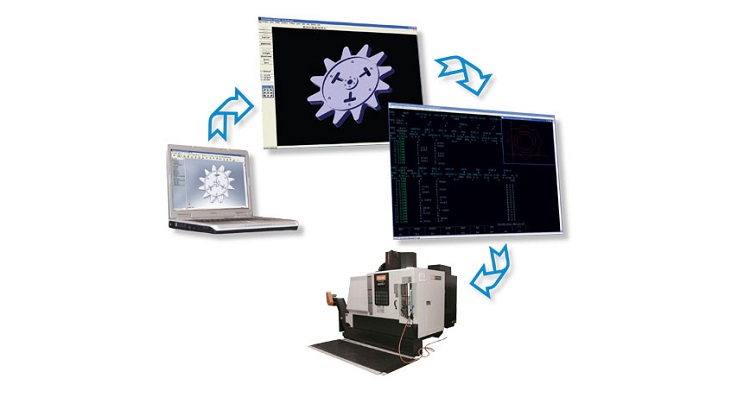
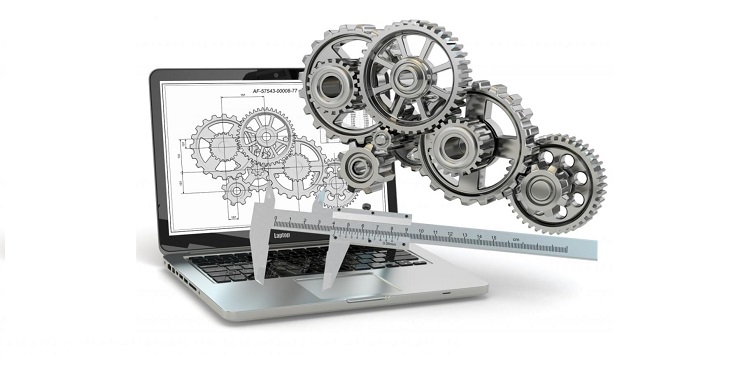
The Hanoi–Quang Ninh High-Speed Railway project represents a major advancement in transportation infrastructure across Northern Vietnam while also imposing stringent requirements for accuracy in surveying, construction, and asset management. In the era of digital transformation within the construction industry, 3D Scanning technology is emerging as a critical solution for capturing highly accurate as-built data, supporting quality control, creating digital assets, and enabling smart infrastructure management throughout the entire project lifecycle.
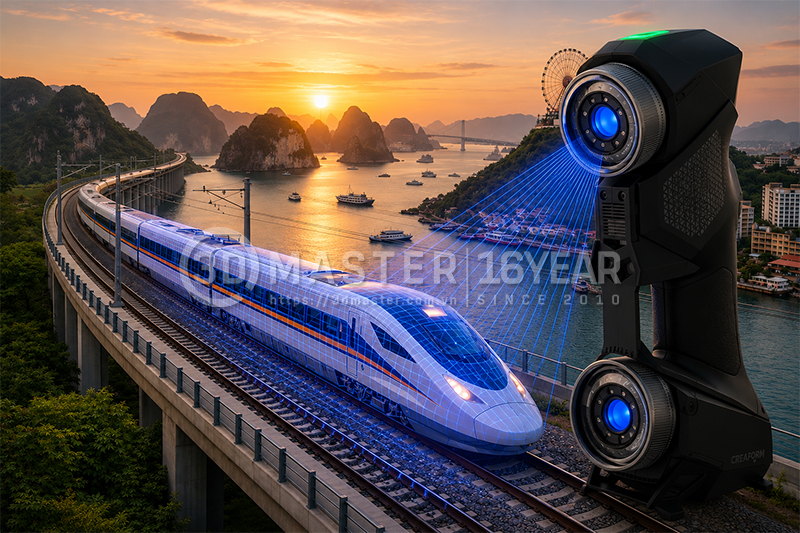
High-speed rail is among the most technically demanding forms of infrastructure in the world today. With operating speeds reaching up to 350 km/h, every component—from tracks, viaducts, tunnels, to stations—must be controlled with exceptional precision.
Even minor deviations in elevation, structural positioning, or track alignment can affect operational safety, asset lifespan, and long-term maintenance costs. Therefore, accurate as-built data is a critical factor throughout the entire project lifecycle.
Traditional surveying methods often capture data only at selected points or cross-sections. This limitation makes it difficult to obtain a comprehensive understanding of existing conditions, especially for large-scale infrastructure projects such as the Hanoi–Quang Ninh High-Speed Railway.
3D Scanning technology enables the capture of millions of measurement points within a short period, recreating the actual geometry of structures in the form of Point Cloud data.
This information provides designers, contractors, and asset managers with a more accurate and visual representation of real-world conditions.
Beyond surveying applications, 3D Scan data also serves as a foundational dataset for BIM, Digital Twin, and modern infrastructure management systems. This is one of the key reasons why 3D Scanning is increasingly adopted in major transportation projects worldwide.
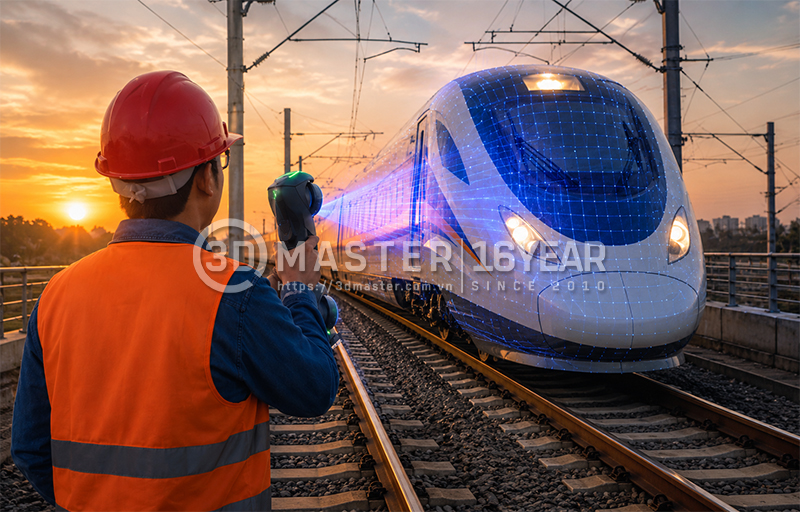
For the Hanoi–Quang Ninh High-Speed Railway project, quality control during construction is a critical requirement.
Given the project's large scale and strict engineering standards, structures such as viaducts, stations, tunnels, and technical systems must be inspected regularly to ensure compliance with design specifications.
3D Scanning technology enables fast and comprehensive collection of geometric data. Captured scan data can be used to verify dimensions, installation positions, and actual geometries of construction components with high accuracy.
By comparing 3D Scan data with design models, deviations can be detected at an early stage. This allows contractors and supervision consultants to make timely corrections before errors impact subsequent construction phases.
In addition to dimensional inspection, 3D Scan data also supports progress tracking and quantity verification with greater transparency. Construction status can be digitized into 3D datasets, enabling more efficient project management.
3D Scanning contributes to higher construction quality while reducing project risks. It also represents a shift from sample-based inspections to comprehensive data-driven quality assurance.

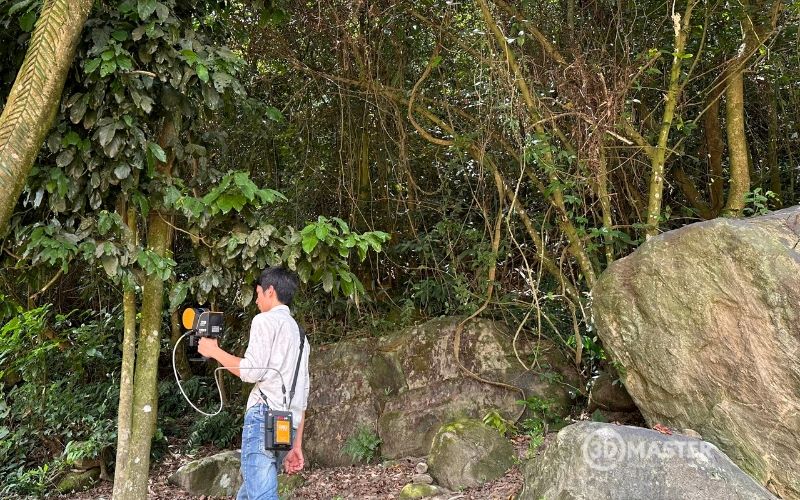
Upon project completion, 3D Scan data can be converted into BIM As-Built models and continuously utilized for project handover and infrastructure asset management.
For the Hanoi–Quang Ninh High-Speed Railway project, digital as-built documentation enables comprehensive storage of information regarding dimensions, locations, and configurations of every infrastructure component.
Beyond railway infrastructure itself, 3D Scanning is also highly beneficial for locomotives, railcars, and complex mechanical assemblies. This is an area where 3D Master has extensive implementation experience.
Through accurate digitization of actual geometries and dimensions, 3D Master can build technical databases that support long-term operation, maintenance, and equipment upgrades.
Key Benefits Include:
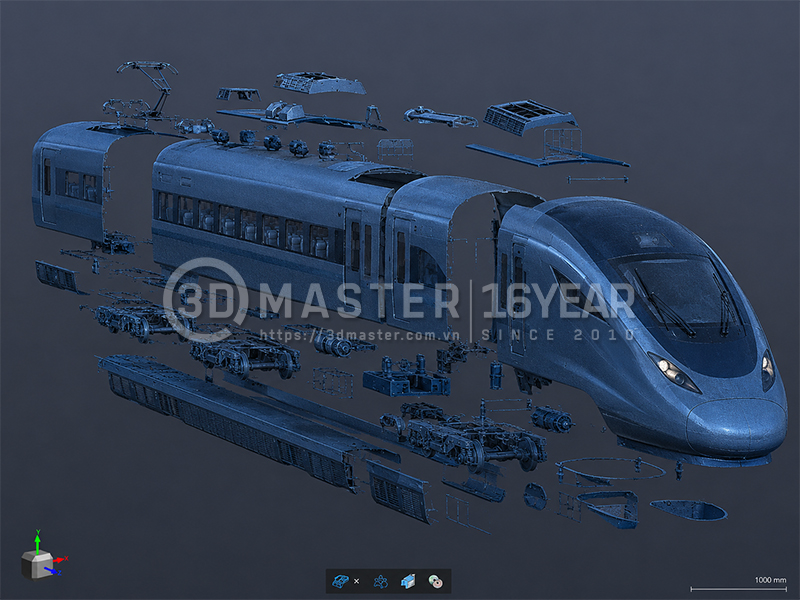
As the railway industry enters the era of digital transformation, Digital Twin technology is becoming a key trend in modern infrastructure management and operation.
A Digital Twin is a digital representation that accurately reflects the real-world condition of an asset, built from 3D Scan data and BIM models.
The implementation of Digital Twin technology will help infrastructure owners and operators:
In summary, for the railway sector in general and the Hanoi–Quang Ninh High-Speed Railway project in particular, 3D Scanning is not merely a surveying tool used during planning, construction, and project handover. It also serves as a strategic data foundation for long-term maintenance, upgrades, and infrastructure asset management.
When integrated with BIM and Digital Twin technologies, 3D Scan data will contribute significantly to the development of a modern, intelligent, and sustainable railway network while enhancing operational efficiency, maintenance capabilities, and future infrastructure development in Vietnam.
With more than 10 years of experience as the official distributor of Creaform 3D Scanning solutions in Vietnam, 3D MASTER provides a complete portfolio of advanced 3D Scanners, demonstration systems, and highly specialized technical expertise.
We are ready to consult, demonstrate, and deploy scanning, inspection, digitization, and reverse engineering solutions for large-scale transportation, railway, and infrastructure projects.
Hotline / Zalo / LINE / Telegram / WhatsApp / Viber / KakaoTalk: +84 982 089 198 | +84 986 333 960
Email: cuong3dmaster@gmail.com | hung3dmaster@gmail.com | tech3dmaster@gmail.com
Website: https://3dmaster.com.vn