How to Choose the Right 3D Scanner for Quality Inspection and Reverse Engineering
How to Choose the Right 3D Scanner for Quality Inspection and Reverse Engineering
Posted Date: 09-06-2026
How to Choose the Right 3D Scanner for Quality Inspection and Reverse Engineering
As digital transformation and smart manufacturing continue to accelerate, 3D scanning technology has become an essential tool for quality inspection, product development, and reverse engineering thanks to its ability to capture data quickly with high accuracy. However, the wide variety of technologies, accuracy levels, and price ranges available on the market often makes it difficult for businesses to select the right solution.
In reality, there is no single 3D scanner that fits every application. The optimal solution is the one that best matches your technical requirements and investment budget. So, how do you choose the right 3D scanner to ensure both technical performance and cost efficiency?
1. What Should You Determine Before Choosing a 3D Scanner?
Before comparing technical specifications or evaluating scanner models, businesses should first clarify the following practical requirements:
Application purpose: Quality inspection, reverse engineering, product development, or 3D data digitization.
Part size: Small components and mechanical parts, or large objects such as molds, vehicle bodies, and industrial structures.
Required accuracy: Define the tolerance level needed to avoid investing in a scanner that is either overly precise or insufficient for the task.
Working environment: Scanning in a metrology lab, manufacturing facility, or field environment.
Portability: Whether the scanner needs to be moved between locations or used primarily in a fixed workspace.
Usage frequency: Daily operation or project-based usage.
Primary application: Dimensional inspection, deviation analysis, or CAD model reconstruction from scan data.
Investment budget: Establish a realistic budget to balance performance, accuracy, and long-term return on investment.
Accuracy is one of the most important factors when selecting a 3D scanner.
2. Risks of Choosing the Wrong 3D Scanner
Selecting an unsuitable 3D scanner can directly impact inspection efficiency, productivity, and overall investment value. Common risks include:
Insufficient accuracy, resulting in unreliable inspection results and potential product quality issues.
Slow scanning speed, reducing inspection productivity and increasing data processing time.
Poor performance on challenging materials such as shiny metals, reflective surfaces, or dark-colored objects.
Incomplete scan data, making reverse engineering and technical analysis more difficult.
High investment costs without fully utilizing the scanner's capabilities.
Limited compatibility with existing inspection software or CAD/CAM systems.
Increased operating costs due to the need for additional equipment, accessories, or data-processing steps.
Understanding how to choose the right 3D scanner from the beginning helps businesses optimize budgets, improve operational efficiency, and maximize long-term investment value.
Mold inspection using a Creaform 3D scanner.
3. How to Choose the Right 3D Scanner for Measurement Applications?
Step 1: Evaluate the Size and Scale of the Objects to Be Scanned
The size of the object directly influences the type of scanner, measurement volume, and accuracy requirements.
Small parts (< 500 mm) Typically require high accuracy to capture fine geometric details. Examples include cast parts, automotive lights, gears, and small plastic components.
Medium to large components (500 mm – 2,500 mm) Often involve complex assemblies that require flexible scanning solutions. Examples include sand-cast parts, gearboxes, seats, and automotive bumpers.
Extra-large structures (> 2,500 mm) Require a large tracking volume to maintain accuracy across the entire surface. Examples include automotive body frames, EV battery trays, and aerospace engine casings.
Step 2: Define Accuracy and Measurement Tolerance Requirements
Many users assume that higher accuracy is always better. However, ultra-high accuracy is not necessarily the most cost-effective solution.
Accuracy requirements should be determined according to the actual application:
Ultra-high accuracy (0.005 mm – 0.02 mm): Suitable for aerospace, precision molds, medical devices, and GD&T inspection.
High accuracy (0.02 mm – 0.05 mm): Common in industrial manufacturing for dimensional inspection, assembly verification, and reverse engineering.
Standard accuracy (0.05 mm – 0.1 mm): Suitable for scanning large objects, deformation analysis, and general shape digitization.
Step 3: Assess Working Conditions and Material Types
Beyond size and accuracy, consider the operating environment and object characteristics:
Need a wireless 3D scanner? Ideal for large production facilities, field applications, or projects requiring maximum mobility.
Need markerless scanning? Helps reduce preparation time when scanning large objects or high volumes of parts.
What materials will be scanned? For shiny metals, reflective surfaces, or dark materials, prioritize scanners using blue laser technology or advanced ambient light rejection capabilities.
Do the parts contain complex geometries? For deep pockets, narrow gaps, or intricate details, choose a scanner with multiple scanning modes and flexible data acquisition capabilities.
3D scanning solutions for the automotive and manufacturing industries.
4. Quick Guide to Choosing a 3D Scanner Based on Application Requirements
If you're unsure which scanner to choose, consider the following recommendations:
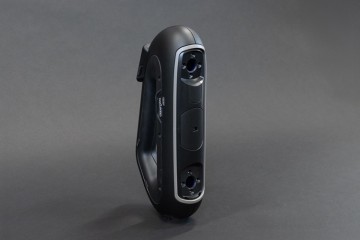
For quality inspection, mold verification, and precision manufacturing requiring maximum accuracy, choose HandySCAN BLACK Elite.
For a versatile 3D scanner that balances performance, flexibility, and investment cost, choose HandySCAN EVO Elite.
For reverse engineering and fast CAD model reconstruction from physical parts, choose HandySCAN PRO.
For scanning large structures such as vehicle bodies, casting molds, EV battery trays, or large industrial equipment, choose the HandySCAN 3D MAX Series.
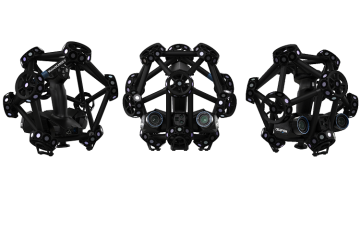
For shop-floor inspection, in-line manufacturing applications, or demanding industrial environments, choose MetraSCAN BLACK Elite.
There is no single 3D scanner that is suitable for every application. The best solution is the one that aligns with your specific requirements. By clearly identifying object size, required accuracy, operating environment, and application goals, businesses can select a scanner that delivers optimal performance while maximizing investment efficiency.
If you need expert consultation or would like to experience Creaform's latest 3D scanning technologies firsthand, 3D MASTER—the official Creaform distributor in Vietnam with over 10 years of experience, a complete range of demo equipment, and a highly specialized application engineering team—is ready to support your quality inspection and reverse engineering projects.
???? Discover the latest generation of 3D scanners at 3D MASTER today.
.jpg)
.jpg)
.jpg)