In modern production lines, the challenge is not only about measuring accurately but also about controlling deviations during operation. That is why automated quality control is increasingly designed as an integrated system, where measurement data, robots, and analytical software operate synchronously in real time.
However, to achieve this efficiency, an AQC system is not simply a measuring device but a tightly integrated combination of multiple components—from measurement hardware and robotic systems to software and data platforms.
So, what exactly makes up an automated QC system, and what role does each component play in the overall process?
Automated Quality Control (AQC – Automated Quality Control System) is a system that applies measurement technologies, sensors, robots, and analytical software to perform product inspection automatically, replacing or minimizing human intervention.
Unlike traditional inspection methods, this system allows:
As a result, quality control becomes an integrated part of the production process rather than a separate step.
In practice, the manufacturing industry is rapidly shifting from manual QC to automated QC, and now toward AI-based QC.
While automated QC handles repetitive tasks, AI-based QC enables systems to learn, identify complex defects, and make predictive decisions based on big data.
Today, automated quality control is widely applied in key industries such as automotive, aerospace, and mechanical machining & mold manufacturing.
A complete automated quality control system typically consists of four main components: measurement hardware, robotic automation systems, analytical software, and data systems.
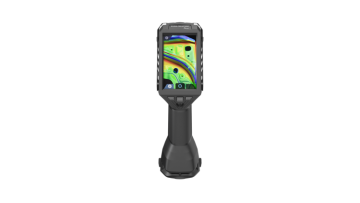
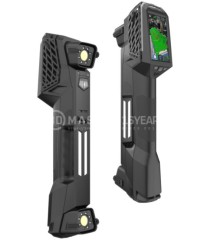
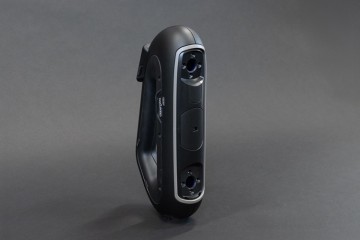
This is the core component responsible for collecting geometric and dimensional data of the product. Common devices include:
In the field of high-precision 3D metrology, Creaform devices are currently leading the trend.
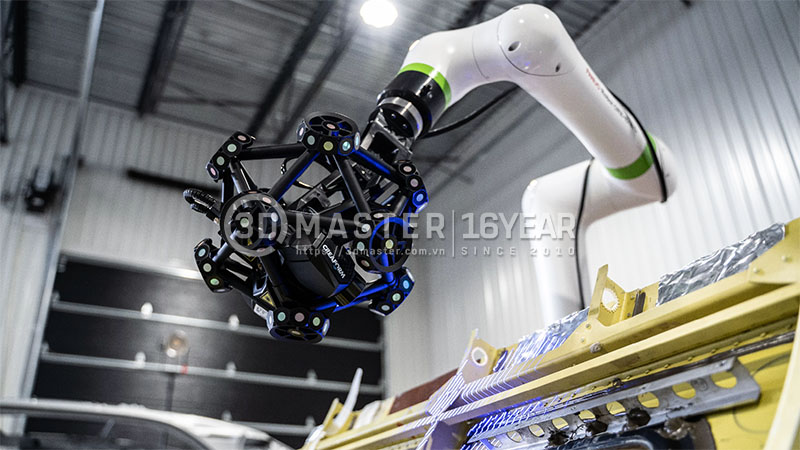
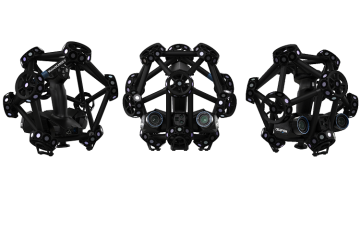
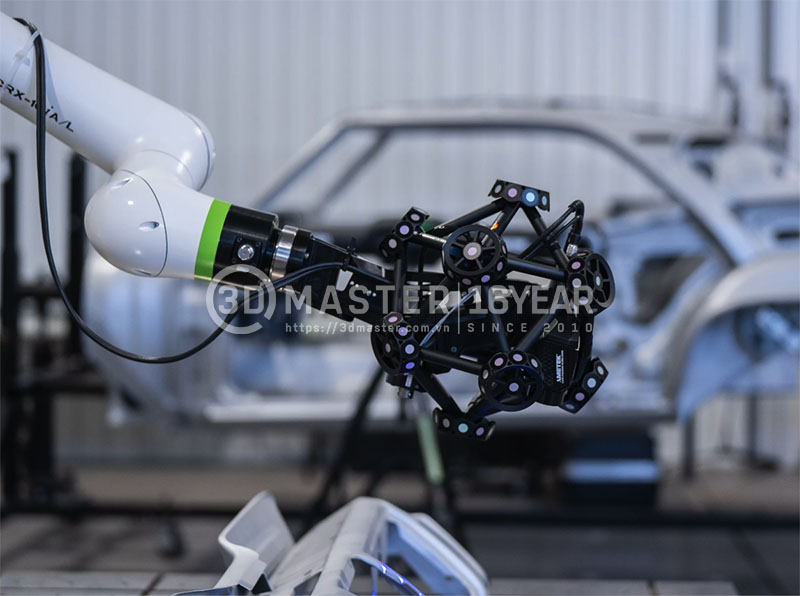
A typical example is the MetraSCAN 3D-R system mounted on a robotic arm, enabling continuous 3D scanning of complex surfaces without reflective targets, significantly accelerating inspection speed.
If measurement hardware is the “eye,” then the robotic system is the “arm” that executes tasks. Multi-axis robotic arms are programmed to move probes or parts along predefined trajectories.
Combined with flexible fixtures, robots can access every angle of a component—even the most difficult-to-measure areas.
The core role of this system is consistency. Robots can operate continuously 24/7 without fatigue-related errors, maintaining stable takt time across the entire factory.
This is where raw data from 3D scanners, cameras, or sensors is processed, analyzed, and transformed into actionable insights for production.
In practice, software goes beyond measurement and comparison—it orchestrates the entire inspection workflow, from planning and data processing to reporting and system integration.
A modern quality control system requires software capable of handling multiple complex tasks simultaneously:
The key differentiator of software in automated quality control systems is its ability to process large datasets in real time, enabling defect detection immediately after production.
With platforms like VXelements from Creaform, businesses can not only achieve precise measurements but also build intelligent, automated, and scalable inspection workflows.
In modern manufacturing, data is the core asset. AQC systems are always accompanied by data management platforms that continuously collect, store, and analyze quality information.
An automated QC system operates in a closed-loop process to ensure continuity, accuracy, and minimal disruption to production.
This entire process takes only a few seconds, enabling continuous quality control without slowing down production.
Implementing automated inspection systems offers significant advantages over traditional methods, especially in speed, accuracy, and overall process control.
With advanced 3D metrology technologies and automation systems, quality control is no longer a bottleneck but a core competitive advantage, helping manufacturers strengthen their reputation in global markets.
When implementing automated quality control, choosing the right partner and technology is critical. 3D MASTER, the official distributor of Creaform in Vietnam, brings over a decade of experience in 3D metrology, offering full demo equipment and a highly skilled technical team ready to consult and deploy real-world solutions.
CONTACT
Hotline - Zalo - LINE - Telegram - WhatsApp - Viber - KakaoTalk: +84 982 089 198 | 0986333960
Email: cuong3dmaster@gmail.com | hung3dmaster@gmail.com | tech3dmaster@gmail.com
Website: https://3dmaster.com.vn