How Does 3D Scanning Digitize Cultural Heritage and Restore Damaged Structures?
How Does 3D Scanning Digitize Cultural Heritage and Restore Damaged Structures?
Posted Date: 08-08-2026
How Does 3D Scanning Digitize Cultural Heritage and Restore Damaged Structures?
Cultural heritage is a priceless asset that reflects the history, identity, and values of each nation. However, under the impact of time, natural disasters, fires, and wars, many structures have seriously deteriorated or even completely disappeared. In this context, cultural heritage digitization using 3D scanning technology is becoming an important solution for accurately storing data, supporting structural restoration, and preserving original values for future generations.
1. Why Is Heritage Restoration Becoming Increasingly Difficult?
Heritage restoration is not simply about rebuilding a damaged structure. It must also ensure accuracy in terms of shape, proportions, patterns, materials, and historical value. Even a small deviation can compromise the authenticity of the heritage.
In the modern era, this work is facing numerous global challenges:
Structures deteriorate over time: Continuous exposure to weather and humidity weakens ancient structures, causing cracks, deterioration, or partial collapse.
Natural disasters and fires: Incidents such as fires, earthquakes, and floods can completely destroy centuries-old structures before emergency response measures can be implemented.
Lack of original data: Many ancient structures have no original design drawings, technical records, or photographic documentation, increasing the risk of inaccurate reconstruction.
Manual measurement is often time-consuming: It can be dangerous for workers when accessing elevated or weakened areas, is prone to measurement errors, and may further damage the surface of heritage objects.
3D scanning captures the current condition of heritage structures
2. Benefits of Cultural Heritage Digitization Using 3D Scanning
Unlike simply taking photographs or performing traditional measurements, 3D scanning captures the complete geometry of a structure as highly accurate digital data.
With the ability to collect millions of measurement points within a short period, this technology is increasingly being adopted by conservation institutes, museums, and research organizations worldwide.
Highly accurate data acquisition: Creates point clouds containing millions of points, accurately recording the dimensions, shape, and current surface condition.
Non-invasive data preservation: The scanning process uses laser beams or optical sensors remotely, without direct physical contact or mechanical impact.
Permanent digital archiving: Creates a "digital replica" stored in a computer environment, eliminating concerns about physical loss or quality degradation over time.
Optimized costs and time: Enables early detection of structural deformation, accurate calculation of required material quantities, and visual construction planning.
Foundation for digital experiences and virtual museums: The collected 3D data can be used to create interactive models and virtual/augmented reality (VR/AR) experiences for education and digital tourism.
Cultural heritage digitization with 3D scanning technology
3. 5-Step Process for Restoring Damaged Structures Using 3D Scanning Technology
To restore a historical structure with a high level of accuracy, conservation organizations often combine 3D scanning with data processing, modeling, and engineering analysis software. The following process helps create a complete digital model that serves as the basis for real-world conservation and restoration.
Step 1: Survey and 3D Scan the Current Condition of the Structure
Depending on the scale of the structure, handheld laser scanners can be combined with drones to ensure comprehensive data acquisition.
Step 2: Process Scanned Data and Build a 3D Digital Model
Raw data, including Point Clouds and high-resolution images, is imported into specialized software for cleaning, registration, and error correction:
Register multiple scans
Remove noise
Generate Point Clouds
Build a 3D Mesh
Convert to a CAD model when required
The result is a complete 3D model of the geometry and material surface, accurately representing the actual condition of the structure at the time of scanning.
Conservation experts combine the current 3D model with historical documents, old drawings, archival photographs, or structures from the same period or with similar architectural characteristics.
Assess the current condition and determine the extent of damage:
Missing details
Deformed areas
Level of deterioration
Restoration potential
This is a critical step in ensuring that restoration is based on scientific evidence rather than assumptions.
Step 4: Digital Restoration
Within CAD/BIM/3D modeling software environments, architects reconstruct destroyed or damaged parts of the structure based on comparative data.
The work may include:
Restoring missing patterns
Reconstructing structural components
Simulating multiple restoration options
Checking feasibility before construction
As a result, every adjustment can be evaluated in the digital environment before being implemented in reality, reducing risks during the actual restoration process.
Step 5: Real-World Restoration Construction
Once the restoration plan has been approved, engineers export technical drawings, cross-sections, and detailed dimensions from the reconstructed 3D model to prepare the documentation for restoration work.
Manufacturing replacement components using CNC or 3D printing
Producing molds
Assembling structural components
Comparing restoration results with the original 3D model
Comparing the 3D model with the restored structure helps evaluate quality and ensures that the structure is reconstructed as closely as possible to its original condition.
4. What Types of Heritage Are Suitable for 3D Scanning Digitization?
Not all heritage assets have the same structure, but most historically significant artifacts and structures can undergo cultural heritage digitization using 3D scanning technology for archiving, research, and restoration.
Architectural structures and historical sites: Temples, pagodas, ancient houses, citadels, mausoleums, and other large-scale structures with complex details.
Ancient sculptures and reliefs: Stone statues, ceramic reliefs, and intricate decorative patterns carved in wood.
Museum artifacts and antiquities: Bronze, ceramic, and stone artifacts, as well as valuable jewelry requiring accurate digital records.
Archaeological sites: Archaeological excavation sites, underground architectural foundations, rock formations, or ancient caves.
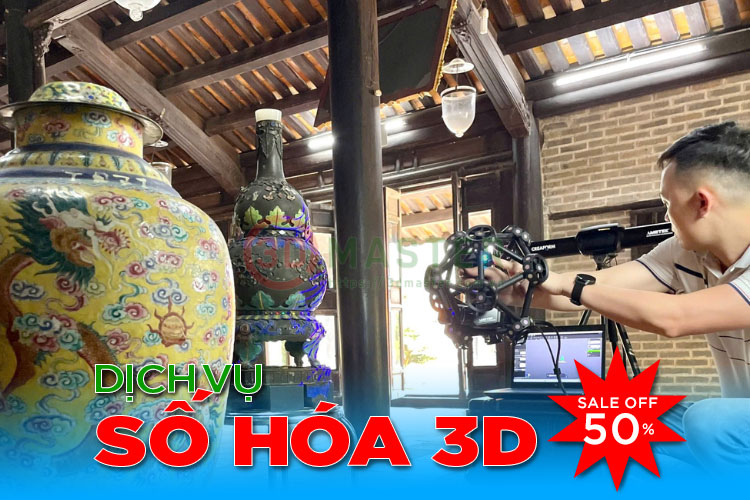
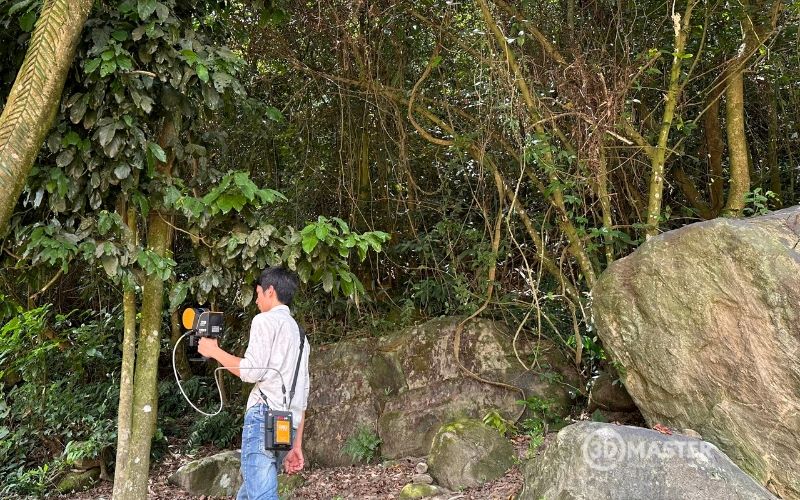
3D scanning of heritage structures using a Creaform scanner
5. When Should Cultural Heritage Digitization Be Implemented?
To maximize effectiveness and minimize the risk of losing heritage information, digitization should be proactively implemented at strategic stages:
Before restoration: Create accurate baseline data for planning, technical solutions, and impact assessments before mechanically intervening with the heritage structure.
After natural disasters: Promptly assess the extent of damage and structural deformation after an incident to develop emergency rescue and accurate restoration plans.
Before relocating artifacts: Preserve the original condition, position, and surface of artifacts before transportation or exhibition transfer.
Before restoration: Provide the most reliable scientific and geometric foundation to ensure restoration achieves maximum accuracy compared with the original.
When building a 3D virtual museum: Create high-quality 3D data resources for virtual exhibitions, cultural promotion, and community education.
When long-term archiving is required: Proactively create digital replicas of heritage assets at risk of rapid deterioration, ensuring that documentation is available for future generations.
In conclusion, cultural heritage digitization using 3D scanning technology has become an important solution for preserving original data, supporting condition analysis, and enabling highly accurate restoration. Beyond conservation, digital data also opens up numerous applications in research, education, digital museums, and the promotion of cultural values to the wider community.
If you are looking for cultural heritage digitization, structural restoration using 3D scanning technology, or professional 3D scanning solutions, contact 3D MASTER for consultation. As an official Creaform distributor in Vietnam for more than 10 years, 3D MASTER has a complete range of demonstration equipment and a team of specialized engineers ready to support heritage conservation, digitization, and restoration projects with high accuracy.
.jpg)
.png)
.png)