With the growing adoption of electric vehicles (EVs), many engineers and quality control specialists are facing new challenges when inspecting components. While traditional vehicles mainly consist of mechanical parts, modern EVs integrate complex electro-mechanical systems controlled by software. Although EVs have fewer moving parts than internal combustion engine vehicles, they feature numerous complex subsystems—all of which directly impact vehicle performance and operation.
To improve product safety and increase output, more and more EV manufacturers are adopting automated quality control systems directly in factories and on production lines. Deviations can be detected and reported instantly to engineering teams for rapid corrective actions. Accelerating the inspection process helps increase throughput and shorten time-to-market.
In today’s challenging labor market, there is a clear shortage of skilled and experienced personnel required to perform effective quality inspections.
Manual inspection methods or traditional coordinate measuring machines (CMMs) are often time-consuming. Both approaches depend heavily on operator performance and are prone to human error. CMMs are typically installed in dedicated metrology rooms, requiring extensive programming, setup, and movement between the production line and inspection area. Moreover, CMMs are not high-speed systems and require expert metrology operators. All these factors significantly slow down the quality inspection process.
In addition, because EV components and subsystems are more complex than those in traditional vehicles, inspection processes require more steps. For example, some traditional inspection technologies are highly sensitive to material surfaces and may require surface preparation, such as powder coating, to ensure accurate measurement. This preparation adds time, is difficult to predict, and—if not done properly—can affect inspection accuracy.
Furthermore, many EV components cannot be reworked. This means that if inspection errors are missed and a non-compliant part enters the production line, the entire line may need to stop immediately. Therefore, EV manufacturers often require 100% inspection of finished products within a predefined cycle before mass production.
Additionally, the automotive industry is shifting toward a “high-mix, low-volume” production model for EVs. This requires quality control teams to frequently modify CMM programs, demanding significant time and expertise from experienced metrology engineers.
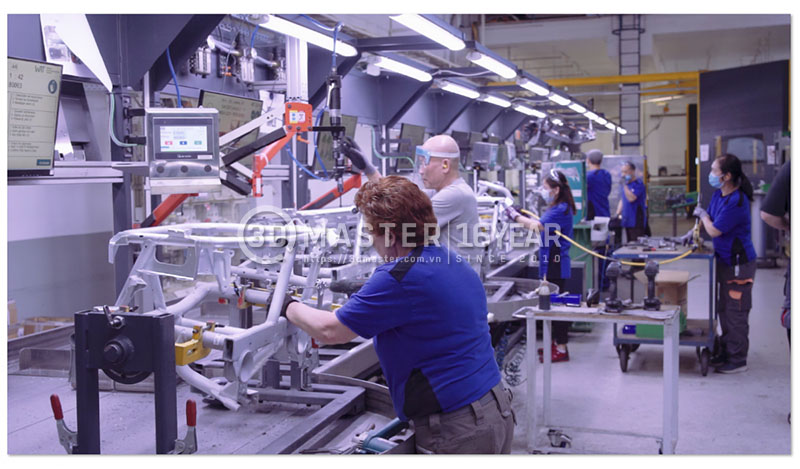
As mentioned, manual or traditional CMM-based inspection methods depend heavily on technician skills, which can affect accuracy, reliability, and repeatability of data.
CMMs are particularly sensitive to vibrations, dust, and humidity in production environments; in fact, they often require installation on isolated concrete foundations to ensure accuracy. This significantly increases deployment cost and complexity.
An important note on accuracy: Traditional CMMs offer extremely high precision—often exceeding actual requirements. For example, the tightest tolerances in stamping or welding processes for surfaces, cut edges, etc., are typically ±0.5 mm, and sometimes up to ±1.0 or ±1.5 mm. Meanwhile, CMM accuracy (at micron-level) is 10 to 100 times higher than these tolerances. This indicates that CMMs are sometimes “overly precise” for certain applications. Therefore, CMMs should be reserved for cases requiring ultra-high precision, while faster technologies should be used for inspecting most components.
Creaform’s R-Series™ 3D scanning solutions for automated quality control are an ideal choice for EV manufacturers seeking to improve inspection efficiency while maintaining accuracy—without relying on highly skilled technicians.
MetraSCAN 3D-R™ is a powerful robot-mounted optical CMM 3D scanner that can be deployed in any automated quality control workflow for at-line inspection. Whether in high-mix, low-volume or low-mix, high-volume production, MetraSCAN 3D-R can be configured as a turnkey solution with the C-Track optical tracking system in a CUBE-R™ cell or in a custom setup.
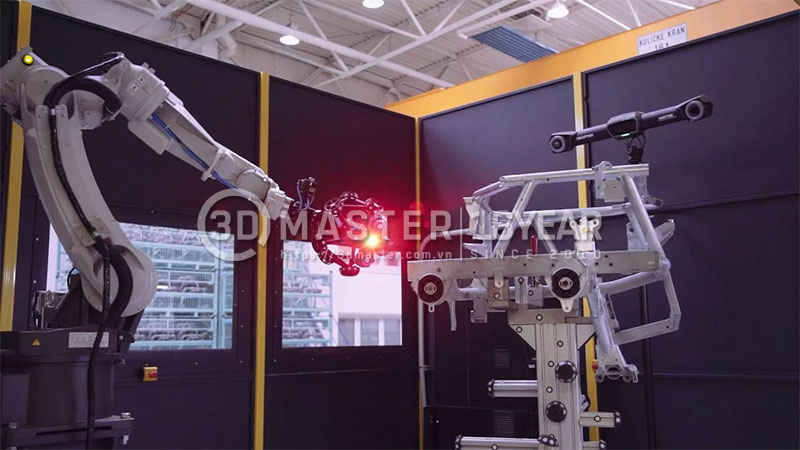
Whether deployed as a turnkey or customized solution, MetraSCAN 3D-R enables EV manufacturers to perform faster inspections with appropriate accuracy levels—without requiring highly specialized technical teams.
Moreover, the system can be quickly integrated into production lines without extensive training or major disruptions.
Thanks to its optimized and user-friendly design, MetraSCAN 3D-R can be installed in just one week. Technicians of all skill levels can be trained within a single day. This helps address workforce challenges and minimize downtime during system deployment.
As EV manufacturers face increasing pressure to bring products to market faster, automated quality control solutions like MetraSCAN 3D-R meet the demand for rapid data acquisition without compromising accuracy, reliability, or repeatability.
Some companies have reduced inspection time from hours to just minutes using MetraSCAN 3D-R—while still ensuring components meet technical and regulatory requirements. Increased inspection capacity directly contributes to higher production output.
Walter Automobiltechnik GmbH, a well-known German supplier of components and parts for major automotive and motorcycle OEMs, recently added two MetraSCAN 3D-R systems to its customized automated quality control setup to evaluate EV engine mounts and maintain short production cycles.
These engine mounts are made from welded structural components with complex geometries, making inspection difficult and time-consuming. Additionally, the parts are made of reflective galvanized steel, further increasing inspection complexity.
By using MetraSCAN 3D-R, which captures large volumes of measurement data within seconds, Walter Automobiltechnik reduced inspection time from 1 hour 30 minutes to just 8 minutes! This level of throughput is nearly impossible to achieve with traditional CMM systems.
MetraSCAN 3D-R also helped the company reduce floor space usage by utilizing compact robots while still covering entire parts. This reduces robot investment costs and minimizes production line modifications due to lower space requirements.
The company plans to deploy additional MetraSCAN 3D-R optical CMM scanning systems in the near future to accelerate more production lines.
In Vietnam, 3D MASTER is proud to be an official distributor of Creaform with over 10 years of experience, offering a full range of industrial 3D scanning equipment. With a comprehensive demo system, customers can directly experience and evaluate performance before investing.
Beyond equipment supply, 3D MASTER also provides a highly experienced technical team with real-world factory deployment expertise, offering consulting – integration – and training services to help businesses quickly adopt technology and optimize production performance.
CONTACT
Hotline - Zalo - LINE - Telegram - WhatsApp - Viber - Kakaotalk: +84 982 089 198 | 0986333960
Email: cuong3dmaster@gmail.com | hung3dmaster@gmail.com | tech3dmaster@gmail.com
Website: https://3dmaster.com.vn