3D Scanning Supports Fast Military Drone Manufacturing, Saving 50% in Costs
3D Scanning Supports Fast Military Drone Manufacturing, Saving 50% in Costs
Posted Date: 26-08-2026
3D Scanning Supports Fast Military Drone Manufacturing, Saving 50% in Costs
Military drones are developed with high requirements for precision, weight, assembly capability, and synchronization between components. During the research and manufacturing process, businesses can use 3D Scanning Technology to digitize components, build CAD models, inspect dimensions, perform reverse engineering, and rapidly create prototypes or sample products, helping optimize the development process, control quality, and support more accurate, faster, and more flexible Drone manufacturing.
Military drones are used for various reconnaissance, surveillance, and information-gathering missions.
What Is a Drone? What Are Military Drones Used For?
A drone is a common term for an unmanned aerial vehicle that can be remotely controlled or operate autonomously using integrated software and sensors.
A military drone is an unmanned aerial vehicle designed, equipped, or integrated for defense missions.
Depending on the design, each type can perform one or multiple different missions.
Reconnaissance and Intelligence Gathering (ISR): Observe terrain, detect enemy force positions, and transmit real-time image data to command centers.
Target Designation and Fire Support: Determine precise coordinates and use laser designation to guide artillery, missiles, or aircraft during attacks.
Combat and Direct Attack: Carry explosives, guided missiles, or FPV suicide equipment to destroy armored vehicles, fortifications, and enemy personnel.
Military Logistics and Transportation: Deliver ammunition, essential supplies, and emergency medical materials to combat units operating in isolated or inaccessible areas.
Electronic Suppression and Camouflage: Broadcast signals to jam radar, disrupt the opponent's communication systems, or act as decoys to attract air-defense fire.
In the military context, Drone and UAV are essentially equivalent, but Drone is the more common and easy-to-understand term, often used in communication, media, and introductory materials. Meanwhile, military UAV is more technical and specialized.
Which Drone Components Are Suitable for 3D Scanning for Manufacturing?
During Drone development, many components with complex shapes or high precision requirements can be digitized using 3D Scanning to support design and manufacturing.
Drone Frame: Can be 3D scanned to capture the actual shape, determine dimensions and the positions of connection points, thereby supporting the creation or completion of a CAD model.
Propellers: 3D Scan data can be used to digitize surface geometry, support shape research, and provide reference data for design.
Landing Gear: The shape, hole positions, and connection areas can be accurately captured to support design and manufacturing.
Housing and Protective Covers: Curved surfaces, assembly positions, and clearances can be quickly digitized to support housing design or post-machining product inspection.
Motor Mounts: 3D Scanning helps capture hole positions, mounting surfaces, and overall geometry to support component design or redesign.
Connecting Components and Assembly Locations: 3D data helps accurately determine the positions of holes, pins, contact surfaces, and other important geometric features.
Military drones have many components and small details that are difficult to measure manually.
How Does 3D Scanning Support Fast Military Drone Manufacturing?
3D Scanning to Digitize Drone Components and Structures
3D Scanning is the process of collecting surface geometry data from an object using laser or blue-light scanning equipment to create an accurate digital model.
The process is carried out as follows:
Position the Drone or component securely before measurement.
Establish an appropriate measurement datum (coordinate system) according to the inspection requirements.
Apply marker points (targets) if necessary.
Use a 3D scanner to collect data across the entire area requiring inspection.
Pay close attention to areas with complex shapes or numerous details.
Fully capture mounting surfaces, holes, grooves, connection positions, and other important features.
Compared with manually measuring individual dimensions, 3D Scanning can collect a large amount of geometric data in a short time, helping shorten the product digitization stage and create a 3D database for design.
Combining 3D Scanning with Reverse Engineering to Develop Drone Components
When drawings or complete CAD models are not available, 3D Scanning can be used as the first step in the reverse engineering process.
The process can be implemented as follows:
3D Scan the component or part to be digitized.
Process the point cloud and mesh.
Analyze geometric features.
Identify planes, circles, holes, grooves, and design features.
Create a CAD model based on the 3D Scan data.
Add dimensions, tolerances, and technical requirements.
Finalize the design for machining or prototyping.
This approach helps businesses transform actual geometric data into a digital design model, thereby shortening the time required to build CAD data for components with complex shapes.
In addition, digital data can be stored, edited, and reused for multiple purposes, helping reduce the cost of recreating samples and improving the efficiency of the entire production process.
Compare 3D Scan Data with CAD Models to Inspect Deviations
Comparing 3D Scan data with a CAD model is a method of comparing the actual shape and dimensions of a Drone or component with its original design.
This method is used to determine whether the component conforms to the drawing, identify deviations caused by machining, assembly, collisions, deformation, or wear, and thereby support quality inspection and design improvement.
The specific work includes:
Import the CAD model into the measurement and inspection software.
Bring the 3D Scan data and CAD model into the same coordinate system.
Determine the optimal alignment method.
Compare the actual surface with the designed surface to identify deviated areas.
Create a color map distinguishing positive deviation, negative deviation, and areas within the allowable limits.
Inspect cross-sections at locations requiring evaluation to clearly observe deviations and deformation.
The advantage of this method is that it evaluates the entire surface of the component, helping quickly determine the location and degree of deviation. Visual data can also be stored, shared, and used to compare multiple components or design versions.
Compared with manual measurement or manufacturing dedicated fixtures, 3D Scanning combined with CAD shortens inspection time, reduces disassembly and reassembly operations, and lowers labor costs. At the same time, this method helps detect deviations early, minimizing repair, rework, and rejection of non-conforming products.
Assess the Level of Damage to Determine Whether Components Can Be Restored or Need to Be Replaced
In addition to design purposes, 3D Scan data also provides technicians with a basis for evaluating component conditions during operation:
Assess the level of damage: Classify components into those with minor deviations within acceptable limits, those with cracks/deformation that can be restored, or those with severe damage that poses a flight-safety risk.
Determine the repair method: Develop procedures for straightening, weld repair, or carbon reinforcement for components that remain suitable for reuse.
Decide on replacement and reverse engineering: Evaluate completely broken components to determine whether to recreate the CAD drawings and proceed with new manufacturing.
With accurate geometric data, the decision-making process is shortened, reducing disassembly, manual measurement, and repeated testing, thereby optimizing both repair time and costs.
3D scanning the entire Drone to accurately capture its actual shape after a collision.
Combining 3D Scanning and 3D Printing to Reproduce New Unmanned Aircraft Drone Components Cost-Effectively
When a component no longer has an available drawing or replacement part, the process of 3D Scanning → reverse engineering → 3D Printing can shorten the process of creating prototypes and manufacturing replacement components.
In particular, 3D Printing technology enables direct manufacturing of new components, helping businesses reduce component procurement waiting times by 70% and significantly lower production costs.
The specific process can be implemented as follows:
Step 1: 3D Scan the component to capture its geometry.
Step 2: Process the data by creating a clean point cloud and mesh.
Step 3: Perform reverse engineering to convert the scan data into a CAD model.
Step 4: Refine the design, add tolerances, assembly positions, and technical requirements.
Step 5: Select an appropriate material, which may be polymer, composite, or metal.
Step 6: Use 3D Printing to rapidly manufacture a suitable prototype or component.
Step 7: Perform post-print 3D measurement by rescanning the component and comparing it with the CAD model.
Step 8: Conduct mechanical property testing for load-bearing components or components related to flight safety.
The major advantage of this method lies in its ability to shorten prototype development time and reduce dependence on molds or traditional machining processes.
It should be noted that not every military Drone component is immediately suitable for 3D Printing. Load-bearing, heat-resistant, or flight-safety-critical components require strict validation procedures.
Reputable 3D Scanning Services for Drone Manufacturing and Repair at 3D Master
In the field of military and unmanned aerial equipment (UAV/Drone), requirements for mechanical accuracy and information security are always top priorities.
3D Master is proud to be a pioneering company in Vietnam providing 3D Scanning solutions combined with non-destructive testing (NDT), helping digitize components, perform reverse engineering, conduct dimensional inspection, and support manufacturing quickly and efficiently:
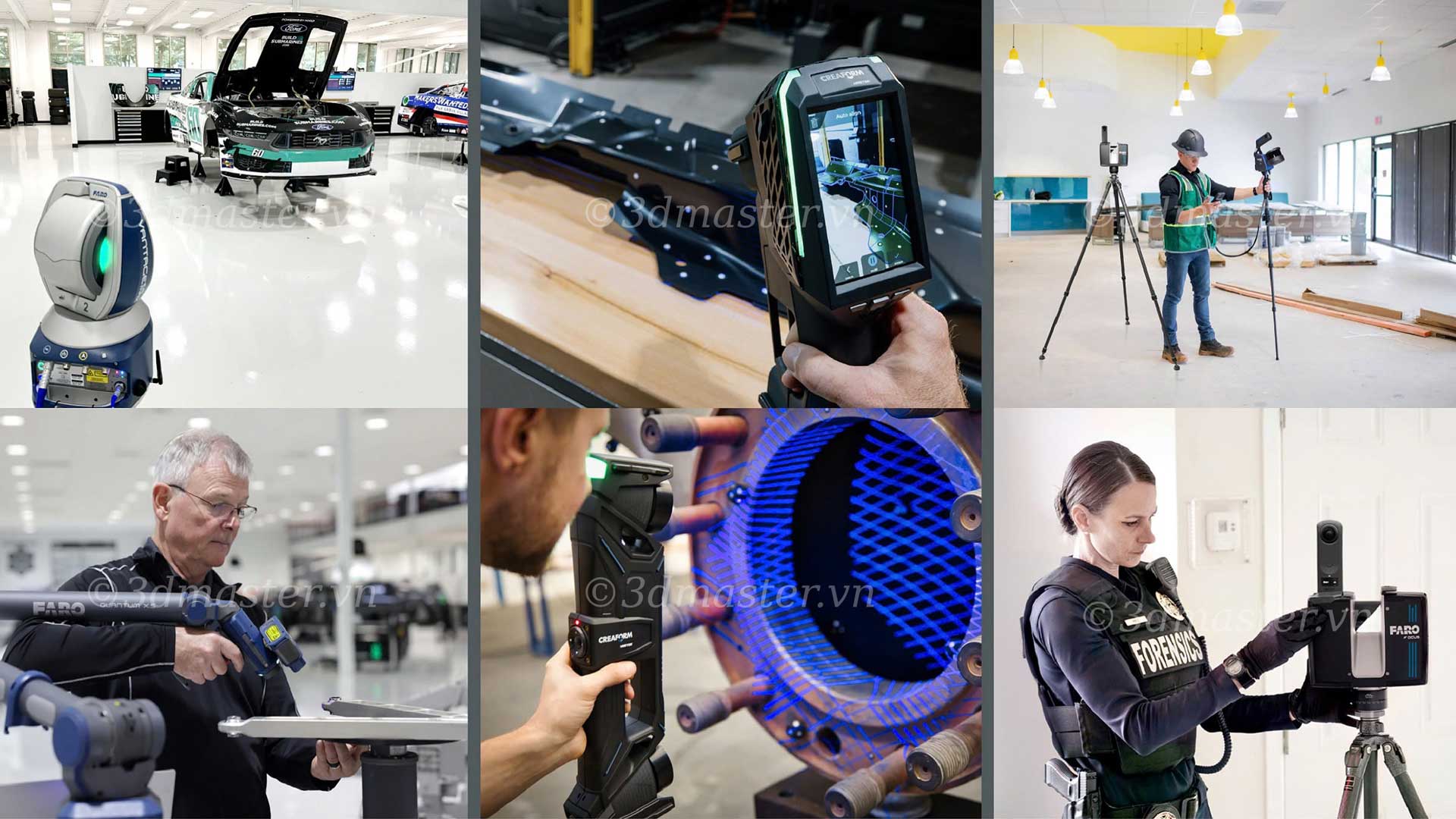
Advanced 3D Scanners from Faro Creaform: Accuracy of up to 0.02 mm and scanning speeds reaching millions of points per second, with performance that is not affected by shiny or dark surfaces.
More than 10 years of specialized experience: Hands-on expertise in precision mechanical engineering, reverse engineering, and supporting the UAV/Drone manufacturing ecosystem in Vietnam.
Save 70% of time & costs: Reduce equipment recovery time from several weeks to just 1–3 days, maximizing budget efficiency for customers.
Flexible on-site service: Ready to bring 3D Scanning equipment directly to the customer's factory, base, or repair facility for on-site inspection.
3D Replacement Manufacturing/Printing & Re-inspection: Support the production of new components using 3D Printing or CNC machining, followed by another 3D Scan to ensure 100% assembly compatibility before delivery.
Absolute information confidentiality commitment: Always comply with strict technical data confidentiality regulations, suitable for specialized aviation equipment and defense projects.
In conclusion, 3D Scanning helps businesses shorten the time required to digitize, design, and inspect Drone components by significantly reducing manual measurement processes. When combined with reverse engineering, CAD, 3D Printing/CNC, and 3D inspection, the product development process becomes faster, more accurate, and more synchronized. As a result, businesses can save labor costs, minimize errors, reduce the number of testing cycles, and optimize production costs.
>>> Save 50% on Military Drone Manufacturing Costs - 3D Scan Now!!!
.jpg)
.jpg)
.jpeg)