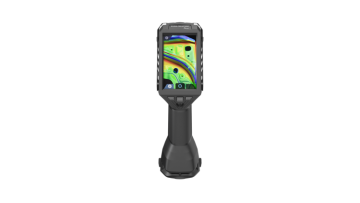
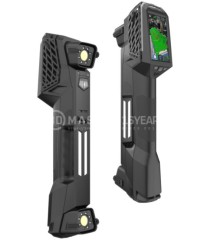
The UAV industry is developing rapidly, with increasing demand across a wide range of sectors, driving the growth of drone manufacturing companies in Vietnam. However, to compete effectively, businesses must do more than simply build products that can fly; they also need to optimize design speed, manufacturing accuracy, and operating costs.
In this context, technologies such as 3D scanning, 3D printing, CNC machining, and automated inspection systems have become key factors in improving manufacturing capabilities and ensuring sustainable development.
.jpg)
A complete unmanned aerial vehicle (UAV) consists of hundreds of mechanical, electronic, and software components. From airframes, propellers, and camera mounts to sensor modules, every component requires extremely high precision.
Today, drone manufacturing companies in Vietnam face several major challenges:
Meanwhile, UAV product life cycles are becoming increasingly shorter. A new design can become obsolete within just a few years. Therefore, businesses need flexible technologies that enable continuous innovation while maintaining production efficiency.
For this reason, an ecosystem of advanced 3D hardware and software is becoming the answer to the challenges faced by Vietnam’s drone industry.
In the UAV industry, accurately digitizing components is particularly important. Drones are often made from composite materials, carbon fiber, and metals with complex geometries, making traditional measurement methods insufficient.
One suitable solution is the Faro Creaform HandySCAN 3D EVO Series, a metrology-grade handheld 3D scanner. The device features high accuracy (up to 0.020 mm), fast scanning with multiple blue laser lines, and stable operation even in manufacturing environments.
This industrial 3D scanner enables businesses to:
For drone manufacturers in Vietnam producing military or specialized UAVs, reverse engineering significantly reduces research and testing time.
Another advantage of 3D scanning technology is its ability to capture data from challenging surfaces such as carbon fiber, reflective materials, and highly curved components.
.jpg)
Previously, producing UAV prototypes could take weeks or even months. Thanks to 3D printing technology, this process has been significantly accelerated.
Suitable 3D printers for drone manufacturing and development in Vietnam include the CreatBot D600 Pro3 HS and D400 HS, which are ideal for printing large drone frames requiring high strength and precision.
In drone manufacturing companies in Vietnam, 3D printers are currently used to:
With rapid prototyping capabilities, businesses can continuously improve designs without investing heavily in molds and tooling.
For drone manufacturers and research centers in Vietnam, 3D printing also significantly reduces the cost of new product development.
Choosing the right 3D printer helps optimize both product development speed and long-term manufacturing efficiency.
Although 3D printing technology is advancing rapidly, CNC machining still plays a critical role in drone manufacturing.
In practice, machines such as the STYLECNC ST6060F and ST6060E are suitable for machining small and medium-sized components, while the ST7090-2F is better suited for complex parts requiring high precision in the drone industry.
CNC machines in drone manufacturing companies in Vietnam are used to:
Components such as motor mounts, gimbal assemblies, drone arms, and load-bearing frames require extremely tight tolerances. Therefore, high-precision CNC systems are essential investments for many UAV manufacturers.
In the drone industry, even a minor dimensional or assembly deviation can affect flight performance.
One suitable solution is the HandyPROBE portable CMM, a wireless 3D measurement system offering flexibility and high accuracy for on-site inspections and large-part measurements without complex setups.
Inspection systems help businesses:
Today, many manufacturers are integrating industrial robots with 3D scanners to build automated inspection systems that improve production speed and product consistency.
.jpg)
Modern equipment can only achieve its full potential when connected to the right software ecosystem. For drone manufacturing companies in Vietnam, software acts as the “brain” that coordinates the entire process.
CAD Software: Solutions such as Geomagic Design X and VXmodel support the design of airframes and components, create detailed 3D models, and optimize designs before production, helping shorten product development time.
Simulation Software: Software such as PolyWorks and FARO CAM2 enables aerodynamic simulations, lift-force analysis, structural strength evaluation, and flight performance testing before physical manufacturing.
UAV Control Software: These platforms allow users to program autonomous flight modes, integrate GPS and sensors, and control camera systems, ensuring stable and accurate drone operation.
Data Management Software: Data management solutions synchronize engineering data, manage design versions, control technical documents, and oversee the product lifecycle throughout the manufacturing process.
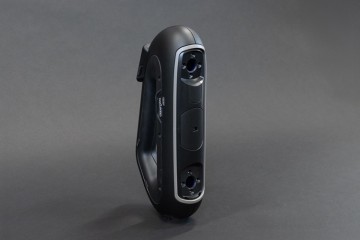
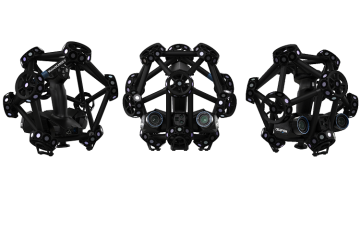
3D inspection technology has become a critical tool that helps drone manufacturers in Vietnam solve key challenges throughout the product lifecycle, from research and manufacturing to maintenance and upgrades.
It enables businesses to:
In the coming years, drone manufacturing companies in Vietnam that master this technological ecosystem will have significant opportunities to lead the rapidly growing UAV market.
To effectively deploy 3D scanning, inspection, and digital manufacturing solutions, businesses can work with 3D Master—a comprehensive 3D technology provider and the official representative of FARO and Creaform in Vietnam for more than 10 years.
3D Master Contact Information:
Hotline / Zalo / LINE / Telegram / WhatsApp / Viber / Kakaotalk: +84 982 089 198 | +84 986 333 960
Email:
Website: https://3dmaster.com.vn