What Is an Optical Scanner? Differences Between 3D Scanners and CMM Machines
What Is an Optical Scanner? Differences Between 3D Scanners and CMM Machines
Posted Date: 11-08-2026
What Is an Optical Scanner? Differences Between 3D Scanners and CMM Machines
Optical scanners have become a breakthrough solution for capturing complete geometric surface data from physical objects with outstanding accuracy and speed. This article provides a detailed analysis of the concept and operating principles of common optical scanning technologies, evaluates their advantages and disadvantages, and clarifies the relationship and key technical differences between optical scanners, 3D scanners, and CMM machines.
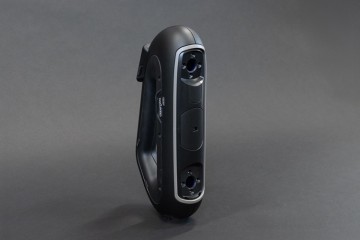
Optical scanner using blue laser light technology
1. What Is an Optical Scanner? Common Optical Scanning Technologies Today
An optical scanner is an electronic device that uses a light source and optical sensors to analyze and capture images, text, or the surface of a physical object, then converts the captured light data into digital signals (image files, digital documents, or 3D models) for computer processing.
Depending on the intended application (2D document digitization or 3D industrial measurement), optical scanning technologies can be divided into the following main categories:
2D technology: Uses lenses (CCD) or LED arrays (CIS) to capture reflected light and convert documents and paper images into flat image files on a computer.
Code reading & recognition technology: Captures and analyzes images so computers can automatically read barcodes/QR codes, recognize printed text, or identify marked answer boxes in multiple-choice tests.
3D technology (Structured Light/Laser): Also known as an optical 3D scanner. Projects light patterns or laser beams onto an object to measure deformation/reflection time, thereby reconstructing an accurate three-dimensional model.
Optical scanner using blue laser light technology
2. What Are the Advantages and Disadvantages of Optical Scanners?
Depending on whether they are used for 2D document scanning or 3D model measurement, optical scanners have the following key advantages and disadvantages:
Advantages of Optical Scanners
Non-contact scanning: Uses only light beams/lasers to collect data without mechanical contact, preventing deformation, scratches, or damage to the object.
Extremely fast digitization: Can capture millions of data points or scan an entire document page/QR code within just a few milliseconds to a few seconds.
High accuracy and detail: Modern optical sensors can capture extremely small details or achieve 3D dimensional measurement accuracy at the micrometer level.
Flexible digital data: Data can be easily converted directly into computer-processable formats such as PDF/Word (using OCR), payment QR codes, or CAD/STL files for 3D printing and manufacturing.
Disadvantages of Optical Scanners
Sensitive to object surfaces: Very difficult to scan transparent, highly reflective/glossy, or extremely dark/light-absorbing surfaces.
Dependent on ambient lighting conditions: Excessively bright or dark lighting can interfere with sensors, causing color inaccuracies or loss of 3D coordinate points.
Limited by line of sight: Hidden areas, deep holes, or internal structures cannot be scanned unless the object is disassembled.
High investment cost for specialized models: High-accuracy optical scanning equipment, especially industrial 3D scanners or CCD art scanners, can be very expensive.
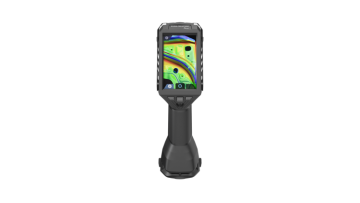
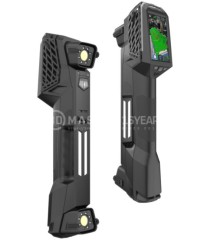
Laser 3D scanner with non-contact scanning capability
3. Differences Between Optical Scanners, 3D Scanners, and CMM Machines
3.1 Is an Optical Scanner the Same as a 3D Scanner?
NO. Depending on the approach, a 3D scanner can be an optical scanner (if it uses lasers/structured light), but it is not necessarily an optical scanner (if it uses mechanical sensors or X-rays).
Optical scanner: Refers only to the operating method – USING LIGHT (Laser, LED, infrared, image sensors, etc.) to capture data.
3D scanner: Refers only to the output – CREATING A 3D MODEL (three dimensions: length, width, and depth).
Optical scanning is the broader category, including both flat 2D document scanners and 3D scanners that use light.
The reason many people still consider a 3D scanner an optical scanner is that most 3D scanners today use lasers or structured light. Therefore, the term "optical 3D scanner" is commonly used. However, there are still 3D scanners that are not optical.
3.2 Differences Between Optical Scanners and CMM Machines
When comparing optical scanners in general with CMM machines, these are two devices based on fundamentally different measurement principles and applications:
Optical scanner: Uses light to capture and record images/data into a computer without physically touching the object.
CMM machine: Uses a mechanical probe that directly contacts the object to accurately measure dimensions (length, diameter, perpendicularity, etc.) for mechanical inspection.
Today, optical CMM systems and multisensor measurement systems have emerged, combining multiple measurement methods within a single platform.
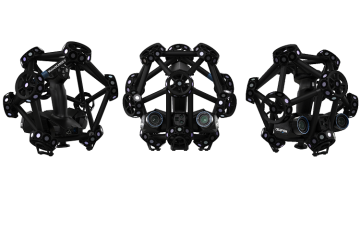
A notable example is Creaform's MetraSCAN 3D series, which is positioned as an Optical CMM system while also supporting probing configurations when combined with HandyPROBE.
MetraSCAN 3D – industrial optical measurement system
4. What Industries Use Optical Scanners?
Optical scanners are widely used thanks to their ability to rapidly digitize data without damaging physical objects. The following are some of the most common application areas:
Office Digitization & Archiving: Uses document scanners to convert documents, books, invoices, and legal papers into digital files (PDF, Word), making records easier to store, search, and manage.
Retail, Logistics & Payments: Uses barcode/QR code readers to inventory goods, manage warehouses, track orders, and process electronic payments in supermarkets and stores.
Healthcare & Dentistry: Scans barcodes on patient wristbands/specimens to prevent identification errors; performs 3D scans of teeth and jaws for dental crowns, orthodontics, or prosthetic limb manufacturing.
Mechanical Engineering & Industrial Manufacturing: Uses optical 3D scanners (3D scanners) to inspect product surfaces, measure components, and perform reverse engineering.
Heritage & Art Digitization: Scans historical documents, paintings, artifacts, or architectural heritage sites for digital preservation without damaging or peeling the original artifacts.
Security & Personnel Management: Recognizes fingerprints and irises or scans passports/ID cards at airports and security checkpoints for identity verification.
Aerospace: Inspects components and complex geometries of aircraft, UAVs, and other equipment requiring high levels of accuracy.
5. Where to Buy Affordable, High-Quality 3D Scanners? - 3D Master
When it comes to high-end optical 3D scanners such as HandySCAN 3D or MetraSCAN 3D, 3D Master is one of the leading names in Vietnam.
With more than a decade of experience, 3D Master is proud to be an authorized official distributor of Faro Creaform (Canada) in Vietnam.
More importantly, instead of simply selling equipment, 3D Master can advise on solutions based on part size and material, required accuracy, inspection, reverse engineering, or digitization objectives, thereby determining the most suitable scanner series and configuration.
If your business is looking for an authentic optical 3D scanner, you can contact 3D Master for advice on the appropriate configuration and explore the possibility of a demonstration using your actual sample.
In summary, optical scanners are non-contact digitization solutions used across applications ranging from document scanning to industrial inspection and 3D model reconstruction. In particular, optical 3D scanners offer advantages in speed, accuracy, and comprehensive data acquisition, making them suitable for quality inspection, reverse engineering, and product digitization. Equipment selection should be based on the intended application, part size, and accuracy requirements.
.png)
.jpg)
.jpg)
.jpg)