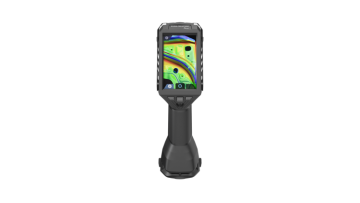
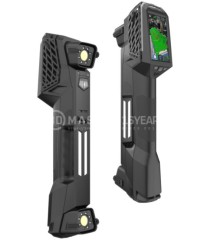
In today's digital era, unmanned aerial vehicles (UAVs) are transforming industries ranging from agriculture and surveying to emergency response. But do you truly understand what a UAV device is, and why controlling manufacturing deviations at the micron level is crucial to ensuring flight stability, safety, and overall performance?
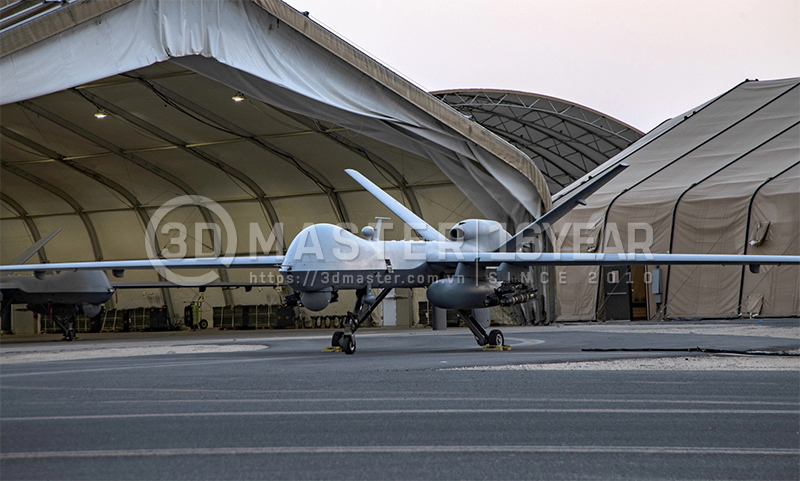
A UAV (Unmanned Aerial Vehicle) is an aircraft that operates without an onboard pilot. It is remotely controlled through a ground control station or handheld controller, or it can fly autonomously using pre-programmed flight paths supported by GPS/GNSS navigation systems.
Unlike conventional ground-based mechanical equipment, UAVs operate in an aerial environment where they are continuously affected by aerodynamics, wind disturbances, and gravity.
As a result, manufacturing UAV frames, fuselage structures, and moving components requires dimensional accuracy at the micron level.
Even a geometric deviation or mass imbalance as small as a strand of hair can lead to serious consequences:
In real-world manufacturing, engineers often believe a component is perfectly machined simply because it matches CAD dimensions.
However, once the UAV takes off, unexpected issues such as drifting, instability, or excessive battery consumption may still occur.
These problems are rarely caused by flight software. Instead, they originate from hidden mechanical deviations that traditional inspection methods fail to detect.
Measuring only with calipers after machining
Calipers and micrometers cannot accurately evaluate complex geometric tolerances such as flatness, roundness, concentricity, or freeform surface deviations.
Failing to detect deformation in carbon fiber or composite frames
During molding and curing, carbon fiber components may shrink or warp slightly—changes that are virtually impossible to detect using conventional measuring tools.
Components assembled despite being misaligned
Fasteners may still fit due to clearance tolerances, allowing motors to be mounted even though the overall assembly has already become misaligned and mechanically stressed.
Reverse engineering using manual measurements
Recreating 3D CAD models with handheld measuring tools inevitably alters aerodynamic curves and freeform surfaces, leading to inaccurate tooling and production.
No full-system inspection after final assembly
Although every individual component may meet specifications, assembly forces generated during fastening can twist the entire structure and shift the UAV's center of gravity.
To overcome the hidden dimensional errors that conventional inspection methods cannot identify, 3D scanning has become an essential technology throughout modern UAV manufacturing.
Throughout UAV production, 3D scanning functions as a high-precision digital inspection system capable of capturing complete surface geometry for every manufacturing stage.
Reverse engineering when CAD files are unavailable
Digitize fuselage structures, propellers, battery compartments, and other components to recreate accurate CAD models.
Inspecting machined or 3D-printed parts
Capture actual component geometry immediately after production to identify dimensional deviations before assembly.
Comparing scan data with CAD models
Overlay scan data with original CAD files and generate color deviation maps that clearly visualize micron-level discrepancies.
Verifying assembly fit
Perform virtual assembly simulations using real-world scan data to eliminate mechanical interference before physical assembly.
Detecting deformation after impact or prolonged use
Evaluate structural fatigue, hidden cracks, and frame distortion following crash tests or operational service.
Accelerating next-generation UAV development
Transfer scan data directly into CFD software to optimize aerodynamic performance and improve product design.
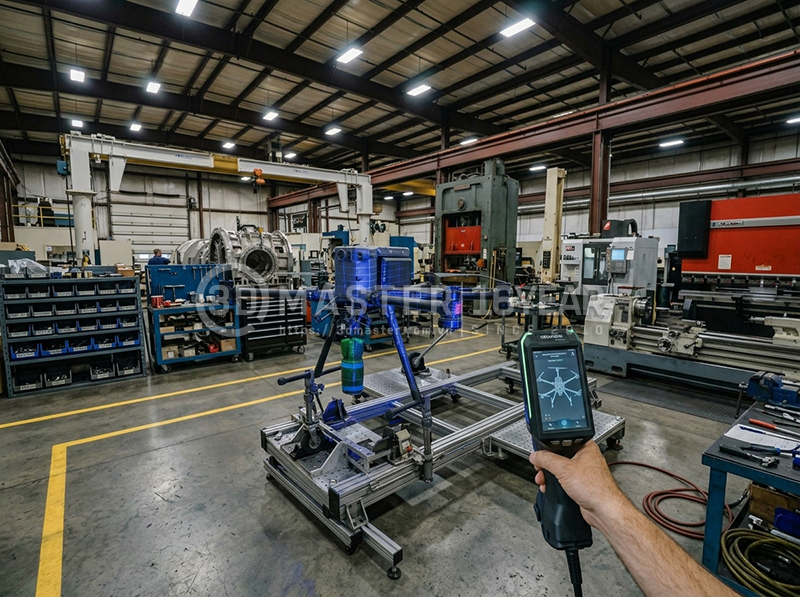
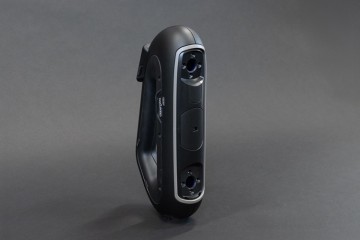
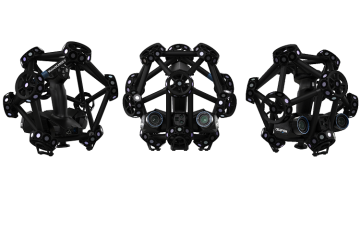
To satisfy the demanding metrology requirements of aerospace and UAV manufacturing, Creaform HandySCAN EVO offers several significant advantages.
Metrology-grade accuracy
Achieves accuracy up to 0.020 mm (deviation below 0.05 mm) and complies with ISO 17025, making it ideal for high-precision dimensional inspection.
Dynamic referencing technology
Maintains exceptional accuracy and repeatability even when surrounding machinery or operators introduce environmental vibration.
Excellent performance on carbon fiber and complex geometries
Its blue laser technology with 46 laser crosses plus 16 additional laser lines captures dark, reflective, and carbon fiber surfaces without requiring scanning spray.
Wireless operation
Provides engineers with complete mobility when scanning large UAV assemblies or prototypes without cable restrictions.
Integrating 3D scanning into quality inspection delivers not only technical improvements but also measurable business value.
Detect manufacturing errors during product development
Identify dimensional deviations during R&D before costly failures occur during flight testing.
Reduce prototype iterations
Accurate digital verification significantly decreases repeated prototype manufacturing and testing.
Lower tooling and rework costs
Early detection of shrinkage and deformation minimizes expensive mold modifications and remanufacturing.
Accelerate time-to-market
A faster inspection workflow shortens the entire development cycle, enabling manufacturers to introduce new UAV products more quickly.
Build long-term digital assets
Create standardized digital twins for future maintenance, product upgrades, reverse engineering, and mass production.
In Vietnam, 3D Master has more than ten years of experience delivering complete 3D scanning and reverse engineering solutions for aerospace applications and UAV manufacturing.
Authorized Creaform distributor
3D Master supplies genuine Creaform HandySCAN EVO systems and other professional blue laser scanners, ensuring industry-leading measurement accuracy.
Extensive expertise in mechanical engineering and aerodynamics
Its engineering team understands UAV structures and captures complete scan data, including hidden features, joints, and complex wing geometries.
Professional reverse engineering capabilities
Processes point cloud data into high-quality CAD formats (STEP/IGES) with smooth, accurate surfaces suitable for manufacturing.
Strict NDA confidentiality
Comprehensive confidentiality agreements protect customers' intellectual property, proprietary UAV designs, and engineering data.
We hope this article has helped you understand what a UAV device is and why 3D scanning has become an essential technology for improving UAV flight stability and manufacturing quality.
If your company is looking for a high-precision solution for dimensional inspection, reverse engineering, or UAV digitization, contact 3D Master today for professional consultation.
3D Master Contact Information
Hotline / Zalo / LINE / Telegram / WhatsApp / Viber / KakaoTalk:
+84 982 089 198 | +84 986 333 960
Email:
Website: