Vietnam-manufactured UAVs are gradually establishing their position through remarkable technological advances. Moving beyond simple assembly, many domestic companies have begun mastering the entire process, from design to inspection. This article explores the development journey of UAVs using 3D technologies—from the initial concept to the moment the product is ready for takeoff.
.jpg)
The demand for unmanned aerial vehicles (UAVs) in Vietnam continues to grow. Domestic companies are shifting from outsourcing and assembly models toward research and the production of complete products. This transition requires greater capabilities in design, testing, and quality control.
Previously, many companies relied heavily on imported components. Today, numerous enterprises have gradually mastered critical stages such as aircraft frame design, aerodynamic optimization, and the manufacturing of specialized components.
3D technology plays a key role in this transformation. It provides the foundation for shortening research cycles and improving product accuracy.
The most common 3D technologies applied in Vietnam-manufactured UAVs include:
The combination of these technologies is creating a new development platform for Vietnam’s UAV industry.
The UAV development process begins with the creation of digital engineering models. Engineers use CAD software to design the fuselage, wings, landing gear, propulsion systems, and payload compartments.
At this stage, multiple factors must be carefully analyzed:
Thanks to 3D technologies, engineers can quickly modify dimensions and structures without producing multiple physical prototypes.
Once the design is completed, the model is imported into CAE and CFD simulation systems.
Aerodynamic simulation helps evaluate airflow around the UAV under different operating conditions. Engineers can analyze:
At the same time, structural simulations assess the load-bearing capability of each component.
By performing simulations in a digital environment, companies can detect design flaws long before physical production begins.
Once the design has been validated, engineers begin manufacturing prototypes using 3D printing technology.
3D printing is particularly suitable for the UAV industry because many components have complex geometries and strict lightweight requirements. This technology enables companies to rapidly produce various parts and assemblies:
During the development of Vietnam-manufactured UAVs, large-format industrial 3D printers such as the CreatBot D600 Pro3 HS and CreatBot D400 HS are becoming ideal solutions for prototyping and component production.
In addition to prototypes, certain parts are manufactured using CNC machining or composite materials to meet specific strength and durability requirements.
Rapid prototyping allows Vietnamese UAV manufacturers to evaluate multiple design alternatives within a short period.
This stage determines the quality of the final product before flight testing.
After manufacturing and assembly, UAVs must be inspected to ensure that actual dimensions match the original design.
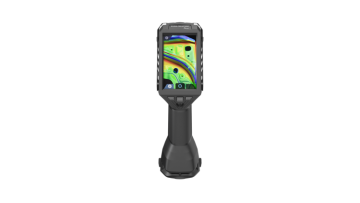
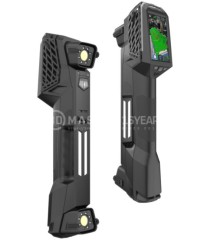
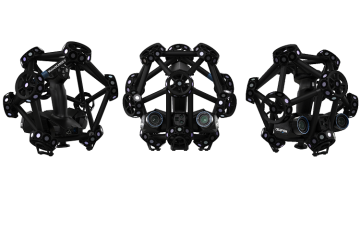
3D scanning technology enables engineers to capture millions of surface data points in a short time. The scanned data are then directly compared with CAD models to identify dimensional deviations.
Typical inspection items include:
For Vietnam-manufactured UAVs, the accuracy of every component can directly affect flight performance and service life.
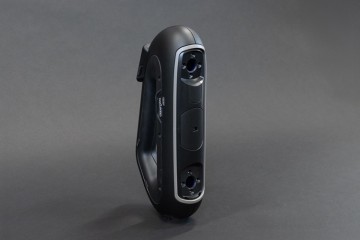
Advanced metrology-grade 3D scanners such as the Creaform HandySCAN EVO can inspect complex carbon-fiber and composite surfaces with high accuracy.
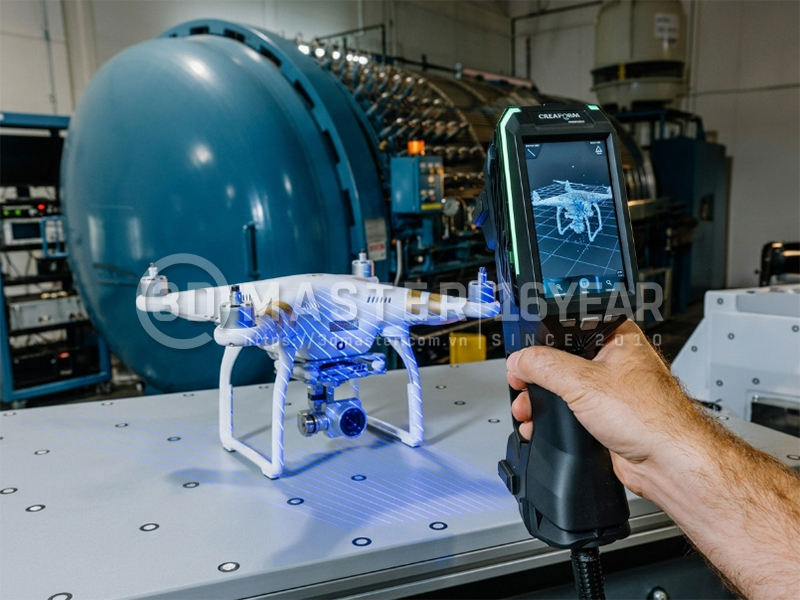
The application of 3D technology not only improves the quality of Vietnam-manufactured UAVs but also creates competitive advantages for domestic enterprises.
From design and manufacturing to inspection, technologies such as CAD/CAE, 3D printing, and 3D scanning help optimize the entire product development lifecycle.
.jpg)
Despite its many benefits, integrating 3D technology into UAV manufacturing still presents several challenges.
The investment required for specialized equipment and software remains a significant obstacle for many companies.
Industrial 3D printers and 3D scanners designed for metal or composite materials are expensive. Likewise, CAE, CFD, and metrology systems require substantial capital investment.
In addition, the market still lacks engineers with expertise in:
To address these challenges, many companies are partnering with professional 3D technology centers in Vietnam.
At the same time, the integration of 3D technology and artificial intelligence is expected to create new breakthroughs for Vietnam-manufactured UAVs in the future.
To develop modern UAV platforms, manufacturers require a robust technological ecosystem covering design, production, and quality inspection.
With more than 10 years of experience distributing 3D metrology solutions in Vietnam, 3D Master provides a wide range of technologies for UAV manufacturing, including:
Devices such as the HandySCAN EVO enable rapid scanning of complex carbon-fiber and composite components. This helps manufacturers improve accuracy and optimize product development time.
As Vietnam's UAV manufacturing industry continues to grow, 3D technology will remain a crucial foundation, enabling Vietnamese companies to gradually master the design and production of UAVs under Vietnamese brands.
Accelerate your UAV manufacturing process – Register for 3D scanning services today!
3D Master contact information:
Hotline / Zalo / LINE / Telegram / WhatsApp / Viber / Kakaotalk: +84 982 089 198 | 0986333960
Email: cuong3dmaster@gmail.com | hung3dmaster@gmail.com | tech3dmaster@gmail.com
Website: https://3dmaster.com.vn