In recent years, UAV aircraft (unmanned aerial vehicles) have become indispensable tools across various industries, ranging from agriculture and topographic surveying to defense and security operations. However, collisions during operation are often unavoidable.
After a collision, even a minor one, the structural frame of a UAV may have changed. Using 3D scanning technology to inspect UAV frame deformation has become a standard solution for ensuring operational safety and maintaining optimal flight performance.
%20(1).jpg)
Many operators tend to rely solely on visual inspection after a UAV incident. If no cracks or visible damage are observed on the exterior shell, the aircraft is often returned to service immediately.
In reality, this poses a significant risk because:
Collision Damage May Exceed What the Human Eye Can Detect
Modern UAV aircraft commonly utilize lightweight materials such as composites, carbon fiber, and aluminum alloys to optimize weight and performance. Following an impact, the frame may develop deformations measuring only a few hundredths of a millimeter.
Although these deviations are often invisible to the naked eye, they can alter load-bearing structures and compromise UAV stability.
Geometric Deviations Directly Affect Flight Performance
When the fuselage frame or mounting assemblies become deformed, the UAV may experience:
Flight instability and imbalance.
Increased energy consumption.
Reduced actual flight endurance.
Excessive vibration during operation.
Sensor and camera data inaccuracies.
For surveying, mapping, and measurement missions, even minor deviations can significantly reduce data accuracy.
Increased Safety Risks During Subsequent Flights
If structural damage remains undetected and unrepaired, the UAV may continue operating in a compromised condition. This increases the risk of loss of control, mid-flight failure, and damage to both equipment and the operating environment.
Depending on the UAV type (fixed-wing or multirotor) and the severity of the impact, common structural deformations include:
Aircraft Fuselage Warping
The main structural axis of the aircraft becomes bent or misaligned relative to its original design.
Motor Mount Misalignment
This alters the thrust vector angle, causing the UAV to drift, yaw, or exhibit unstable flight behavior.
Arm Deformation in Multirotor UAVs
Motor arms may become twisted or shifted from their intended alignment plane.
Fixed-Wing UAV Airfoil Distortion
Changes to the aerodynamic airfoil profile can significantly reduce lift generation.
Damage to Composite and Carbon Fiber Bonding Areas
Strong impacts can cause delamination between carbon fiber layers and composite structures.
Deformation at Sensor and Camera Mounting Locations
This can alter gimbal camera orientation and introduce errors into positioning sensors such as LiDAR and GPS systems.
.jpg)
The emergence of 3D scanning technology has revolutionized structural quality inspection for UAV aircraft. The process consists of several advanced steps:
Capture Complete UAV Geometry in a Short Time
Instead of relying on calipers or manual measurement methods that are time-consuming and prone to errors, a 3D scanner captures the entire UAV surface profile as millions of point-cloud data points within minutes while maintaining metrology-grade accuracy.
Compare the Current UAV Condition with the Original Design
After acquisition, the 3D scan data is imported into specialized software and aligned with the manufacturer's original CAD model.
The software generates an intuitive color deviation map:
Green: Dimensions are within tolerance.
Red/Orange: Positive deviation or outward deformation.
Blue: Negative deviation or inward denting.
Evaluate Impact Severity and Archive Data
Based on the color map analysis, engineers can precisely quantify dimensional deviations in millimeters and determine whether repair, component replacement, or frame retirement is necessary.
Furthermore, the digital inspection data can be archived for maintenance management and lifetime traceability of the UAV.
Today, 3D scanning is widely used to support maintenance and damage assessment across many specialized UAV platforms.
| Application Sector | Typical Situation | Role of 3D Scanning |
|---|---|---|
| Agricultural UAVs | Collisions with trees, power lines, or hard landings in fields | Verify motor shaft concentricity and spraying arm straightness |
| Surveying UAVs | Emergency landings in rough terrain | Detect hidden cracks beneath the fuselage and misalignment of LiDAR sensor mounts |
| Fixed-Wing UAVs | After high-stress flight testing | Measure airfoil profile changes and tail section twisting |
| Military UAVs | After tactical training missions and extended exercises | Conduct comprehensive structural integrity assessments to maintain operational readiness |
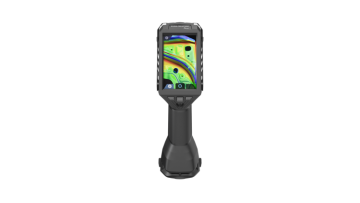
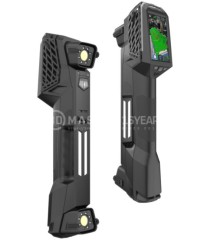
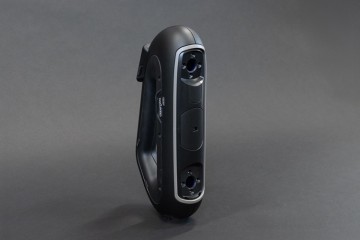
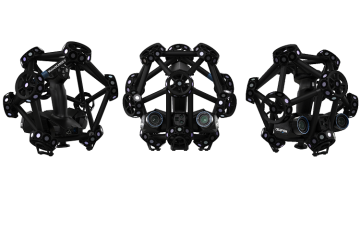
When discussing professional 3D scanning solutions for the aerospace and unmanned aerial vehicle industries, the HandySCAN EVO series from Creaform remains one of the preferred choices among engineers worldwide.
Metrology-Grade Accuracy
HandySCAN EVO delivers accuracy up to 0.020 mm, enabling detection of even the smallest deformations on UAV structures.
Ability to Scan Challenging Materials
Thanks to advanced blue-laser technology, HandySCAN EVO captures carbon fiber and composite structures efficiently without requiring surface powder spraying.
Flexible Handheld Design
Its lightweight and portable design allows engineers to perform inspections directly at flight fields or maintenance facilities without dismantling the entire UAV system.
Inspecting UAV frame deformation using 3D scanning technology is not merely a technical solution—it is an essential process for optimizing operational costs and ensuring flight safety.
Implementing advanced solutions such as the Faro Creaform HandySCAN EVO, officially distributed by 3D MASTER, provides organizations with the technological capability to fully understand, inspect, and maintain their unmanned aerial vehicles throughout their operational lifecycle.
3D MASTER Contact Information
Hotline / Zalo / LINE / Telegram / WhatsApp / Viber / Kakaotalk: +84 982 089 198 | +84 986 333 960
Email:
cuong3dmaster@gmail.com
hung3dmaster@gmail.com
tech3dmaster@gmail.com
Website: https://3dmaster.com.vn