How Are UAVs and Autonomous Mobile Robots Developing in Vietnam?
How Are UAVs and Autonomous Mobile Robots Developing in Vietnam?
Posted Date: 25-09-2026
How Are UAVs and Autonomous Mobile Robots Developing in Vietnam?
UAVs and autonomous mobile robots in Vietnam are gradually moving from experimental projects to practical applications in manufacturing, agriculture, logistics, and infrastructure. These technologies are also being prioritized for development during the 2025–2030 period. The combination of AI, sensors, 3D data, and automation is opening up new development opportunities for Vietnamese businesses. So, how is the UAV and autonomous mobile robotics industry in Vietnam developing?
1. What Are UAVs and Autonomous Mobile Robots? Why Are They Becoming Strategic Technologies in Vietnam?
A UAV is an unmanned aerial vehicle that can be remotely controlled or operate automatically according to a programmed sequence. UAVs can integrate cameras, LiDAR, sensors, and positioning systems. This allows them to collect data or perform tasks from the air.
An autonomous mobile robot (AMR) is a robot capable of autonomously determining its position and moving through real-world environments. The robot does not require direct human control for every movement.
AMRs typically use cameras, LiDAR, and sensors to perceive their surroundings. The system can create maps, detect obstacles, and select appropriate routes.
No longer limited to experimental applications, UAVs and autonomous mobile robots are becoming strategic technology groups in Vietnam during the 2025–2030 period.
Strategic direction: The Government prioritizes the development of automation technologies and unmanned vehicles under the Digital Technology Industry Development Strategy.
Addressing labor challenges: Manufacturing and agriculture are facing rising labor costs and shortages of highly skilled workers.
Optimizing productivity: Autonomous technologies can operate continuously 24/7. These systems minimize human-related errors.
Workplace safety: Robots can replace humans when working in hazardous, risky, or harsh environments.
The two technologies operate differently but share the same objective: transferring sensing, movement, and task execution capabilities from humans to automated systems.
AMR robots transporting goods in a factory
2. UAVs and Autonomous Mobile Robots Are Expanding into Multiple Industries in Vietnam
2.1 UAVs Have Diverse Applications Across Multiple Industries
UAV applications are expanding rapidly in Vietnam. These devices help collect accurate spatial data and optimize large-scale workflows.
Smart agriculture: Precise crop protection spraying. Large-scale seed and fertilizer distribution. Monitoring crop health using multispectral cameras.
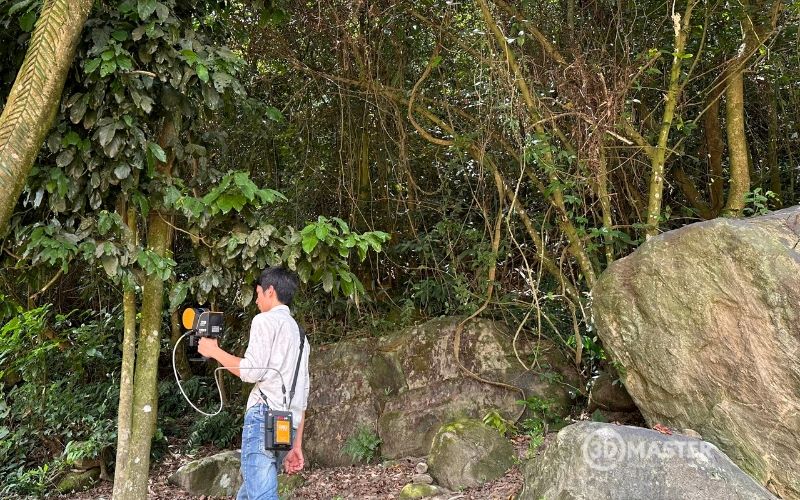
Forestry and natural resources: Monitoring forest conditions. Conducting surveys to calculate areas and create topographic maps. Early detection of forest fire and deforestation risks.
Industry and infrastructure: Inspecting high-rise construction projects. Monitoring high-voltage power lines, wind turbines, and factories.
Logistics and rescue: Transporting medical supplies to remote areas. Searching for missing people and supporting rescue operations during natural disasters, storms, and floods.
Defense and military: Aerial reconnaissance and real-time intelligence collection. Monitoring and protecting borders and islands. Supporting target identification and operations in hazardous environments.
Vietnamese businesses are currently showing a growing trend toward technological self-reliance, shifting from importing UAVs toward designing, manufacturing hardware, and integrating software domestically.
UAVs supporting crop monitoring and agricultural management
2.2 Autonomous Mobile Robots Are Driving Automation
Autonomous mobile robots are developing strongly in environments with repetitive transportation processes. Factories and warehouses are particularly suitable because robots can handle the movement of materials, semi-finished products, or goods between different areas.
AGV/AMR in manufacturing: Automatically transporting raw materials between production lines. Moving goods throughout warehouses without fixed rails.
Patrolling and monitoring: Mobile robots equipped with cameras and sensors can perform security patrols. Devices can monitor temperature and gas leaks in factories.
Core control technologies: AI integrated with LiDAR, 3D cameras, and ultrasonic sensors. These systems help robots create maps through SLAM, determine their position, and avoid obstacles accurately.
Management system integration: Directly connecting with WMS (Warehouse Management System) and MES (Manufacturing Execution System). Data can be synchronized in real time.
Today, the development of autonomous mobile robots in Vietnam is shifting from “robots performing a single task” toward “robots becoming part of an automated operating system.”
Autonomous mobile robots driving automation in factories
3. Challenges and Difficulties in Developing UAVs and Autonomous Mobile Robots
Despite their significant potential, the development of UAVs and autonomous mobile robots in Vietnam still faces various challenges. The difficulties are not limited to hardware manufacturing. Businesses need to simultaneously master mechanical engineering, electronics, sensors, software, AI, and testing processes.
Some of the main challenges include:
Dependence on hardware components: Vietnam is not yet fully self-sufficient in key components such as processing chips, advanced sensors, and servo motors.
Mechanical design and manufacturing: Many components have complex geometries. Businesses need to control the dimensions, weight, rigidity, and assembly position of each component.
High initial investment costs: Small and medium-sized businesses may face difficulties due to substantial initial investment requirements for R&D and infrastructure.
Hardware and software integration: An autonomous robot needs to coordinate its motion mechanisms, sensors, positioning algorithms, and control systems. Poor integration can result in unstable operation.
Regulatory framework and safety requirements: UAV flight licensing regulations remain strict and complex. Safety standards for robots operating alongside humans are still being developed.
Technical workforce: Businesses need teams capable of combining precision mechanics, CAD/CAM, electronics, automation, AI, and 3D data processing.
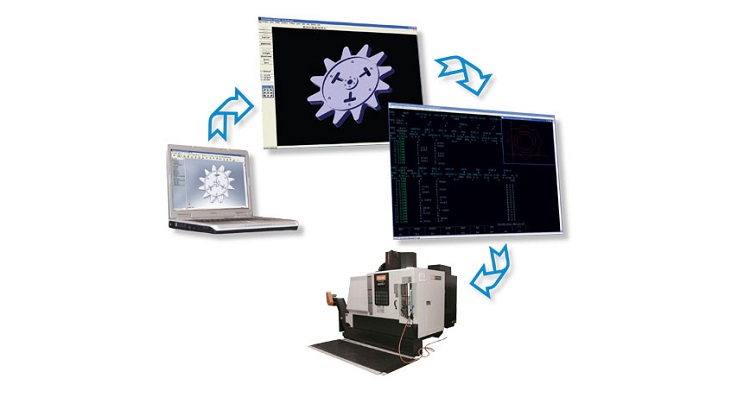
Therefore, developing a complete UAV or autonomous mobile robot requires an integrated product development chain, from sample digitization, design, prototyping, and manufacturing to inspection and improvement.
4. 3D MASTER Supports Businesses in Developing UAVs and Autonomous Mobile Robots
During the development of UAVs and autonomous mobile robots, 3D technology plays an important role. Businesses can use this technology to design components, inspect dimensions, create prototypes, and improve products more quickly and accurately.
If a business is not yet ready to invest in 3D equipment, outsourcing services can be a flexible option for reducing initial costs.
4.1 Breakthrough 3D Solutions Provided by 3D Master for the UAV & Robot Production Chain
3D Master provides a comprehensive 3D technology ecosystem. These solutions help address R&D and manufacturing challenges for Vietnamese businesses.
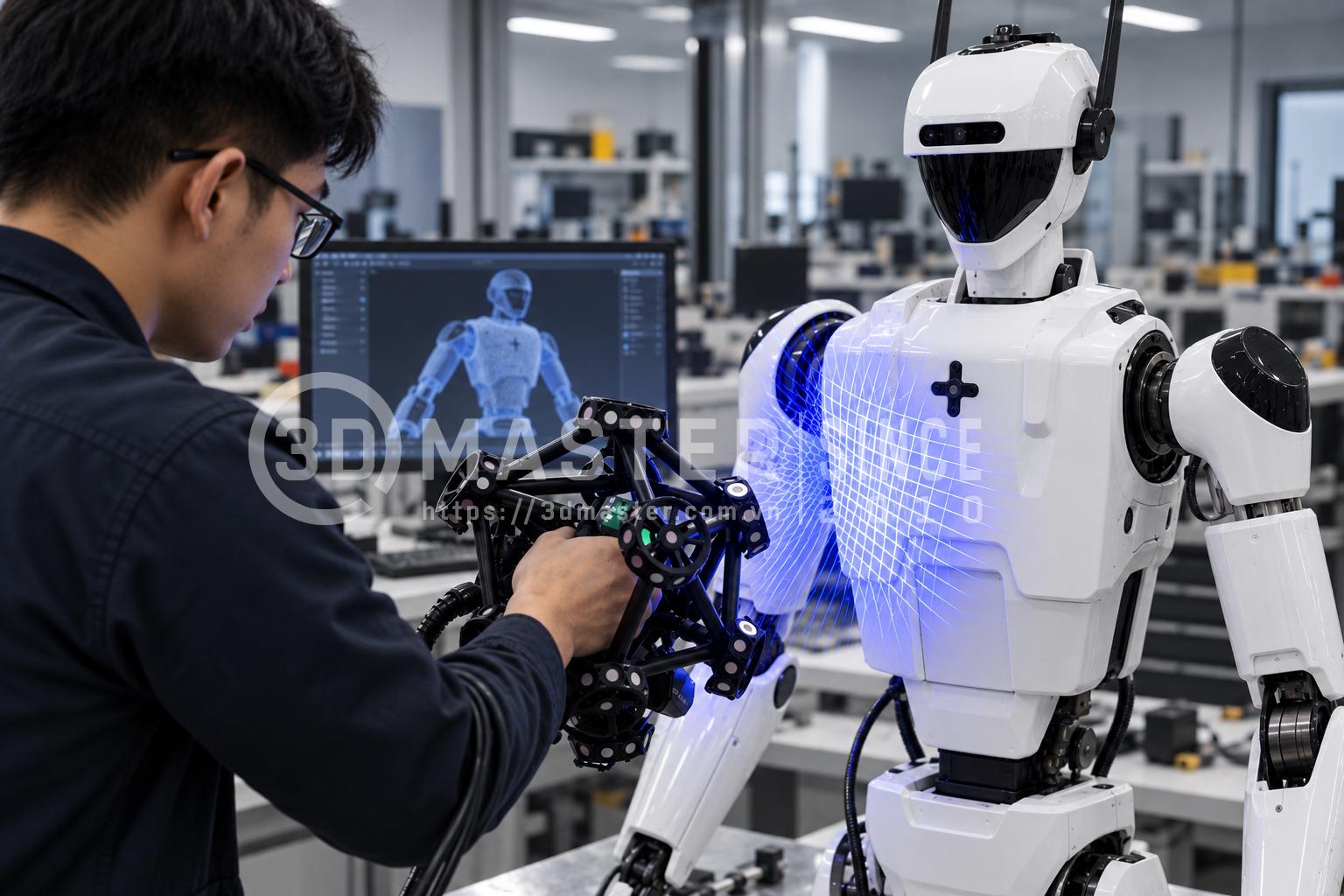
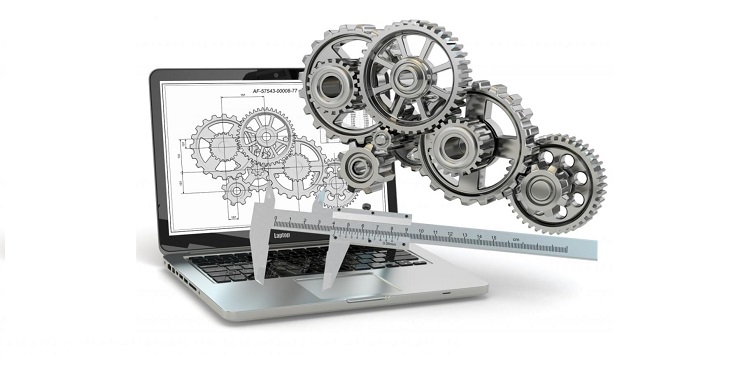
3D Scanning & Reverse Engineering: Rapidly digitizing UAV shells, propellers, or robot chassis. Creating accurate CAD drawings from real-world scan data to improve designs.
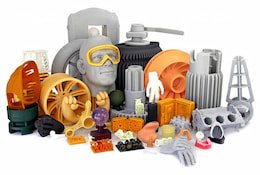
3D Printing Technology for Manufacturing & Rapid Prototyping: Directly manufacturing complex plastic, composite, and metal components. Reducing the weight of UAVs and robots while maintaining structural strength.
3D Measurement & Quality Inspection: Comparing actual product data with original CAD drawings. Accurately detecting manufacturing deviations and ensuring precise mechanical assembly.
3D data can be stored for comparison between different versions. This provides a useful foundation when businesses need to improve designs or control quality across production batches.
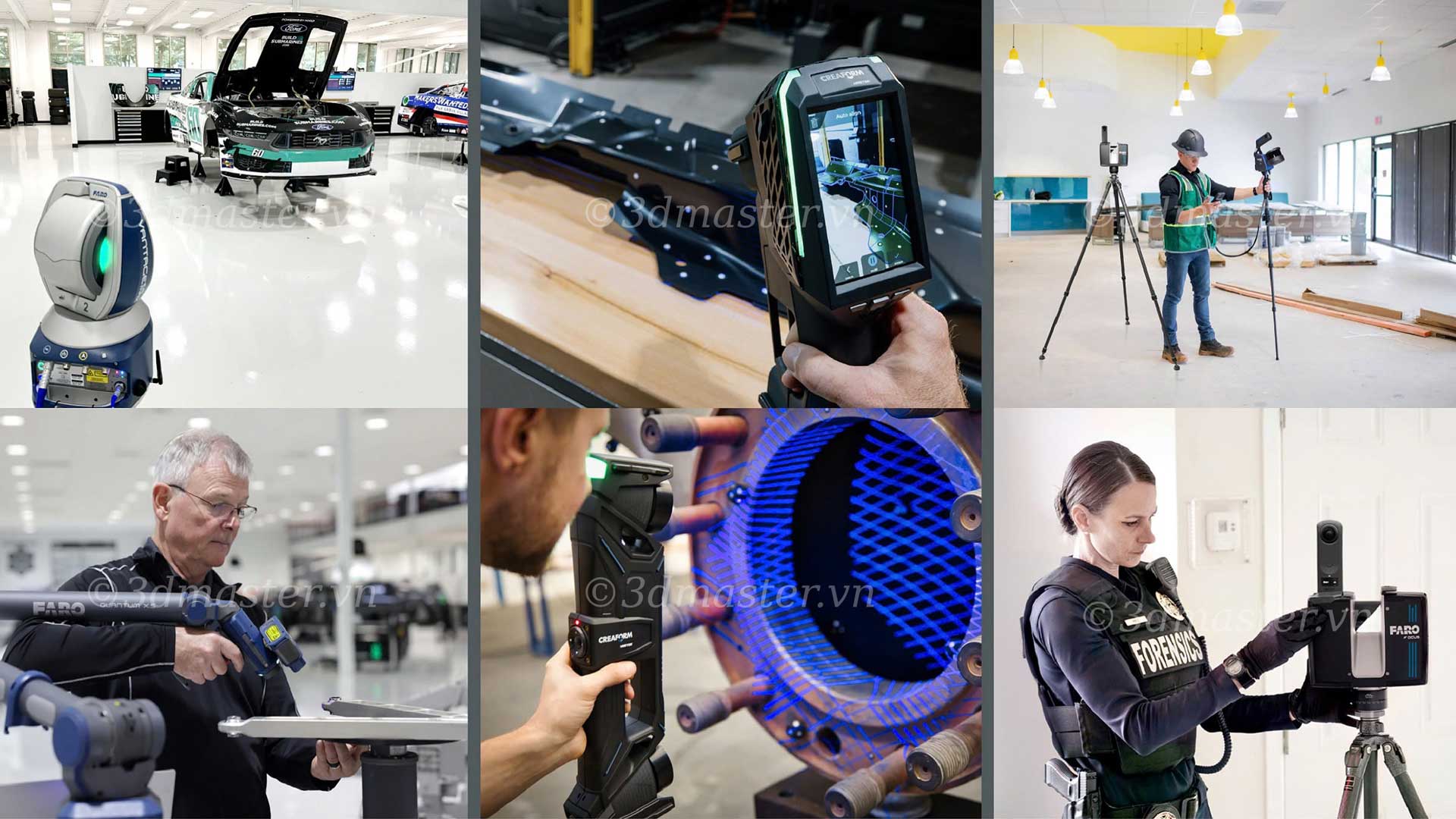
In particular, 3D MASTER operates modern 3D scanning systems from FARO Creaform, along with 3D printers and design software, meeting the needs of digitization, prototyping, and product inspection with high accuracy.
3D scanning supports component digitization during UAV and robot development
4.2 The Practical Value 3D Master Brings to Vietnamese Businesses
Applying 3D Master's solutions helps businesses optimize their competitiveness and accelerate localization.
Cost optimization: Reducing expensive tooling costs during the R&D stage. Minimizing defective products through accurate inspection.
Shortening Time-to-Market: Rapid prototyping with 3D printing technology allows functional testing within days instead of months.
Promoting “Made in Vietnam” products: Supporting domestic businesses in mastering the entire design, manufacturing, and quality inspection process.
Improving quality control: Measurement results help accurately identify deviations and support root-cause analysis during production.
Supporting iterative product development: Businesses can use the data to adjust designs and continue manufacturing subsequent versions.
In summary, UAVs and autonomous mobile robots in Vietnam are expanding their applications while gradually moving toward greater technological self-reliance and domestic manufacturing. To shorten development time, businesses can apply 3D scanning, reverse engineering, 3D printing, and inspection from the early stages. Businesses also need to focus on core technologies, design capabilities, manufacturing, and quality control to create products that meet practical requirements.
>>> Get a consultation on 3D services with special offers for UAV & Robot projects!
.jpg)
.jpg)
.jpg)