The rapid advancement of Artificial Intelligence (AI) and digital technologies is reshaping virtually every industry. Among them, the unmanned aerial vehicle (UAV) industry is experiencing one of the most significant transformations. This article explores how AI combined with 3D scanning technology is helping manufacturers optimize designs, shorten R&D cycles, and strengthen their competitive advantage.
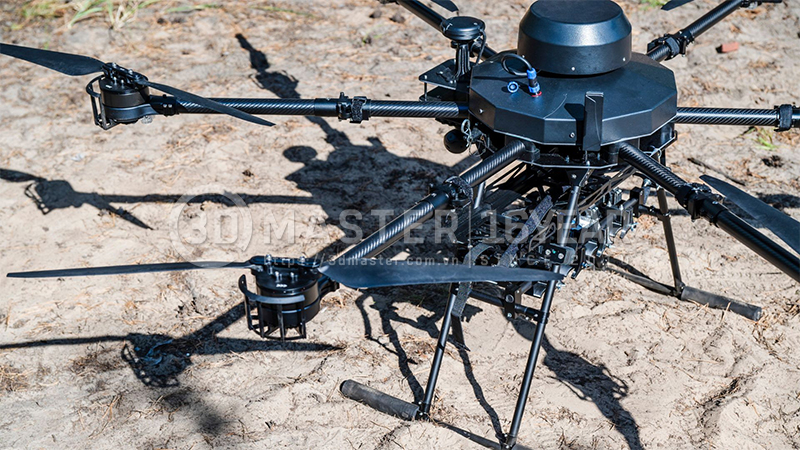
In just a few years, UAVs have expanded far beyond military applications into commercial sectors such as cargo transportation, smart agriculture, land surveying, infrastructure inspection, and search-and-rescue operations.
This rapid expansion creates tremendous pressure on manufacturers. New UAV models must be designed, tested, and launched much faster than ever before.
One of the greatest engineering challenges is designing the airframe and wings. Every geometric detail directly influences:
Aerodynamic drag
Flight stability
Energy consumption
Battery endurance
Payload capacity
To optimize these factors, engineers repeatedly perform aerodynamic simulations, redesign components, and validate them using physical prototypes.
With traditional workflows, every design modification requires new measurements and model reconstruction, significantly extending R&D timelines.
This is why AI is becoming increasingly important in UAV development. AI can analyze thousands of design alternatives, predict flight performance, and recommend optimized solutions.
However, AI can only perform effectively when supplied with highly accurate input data.
This is where 3D scanning technology becomes essential.
Simply put, AI is the "brain," while 3D scanning serves as the "eyes," enabling AI to accurately understand the real geometry of every UAV component.
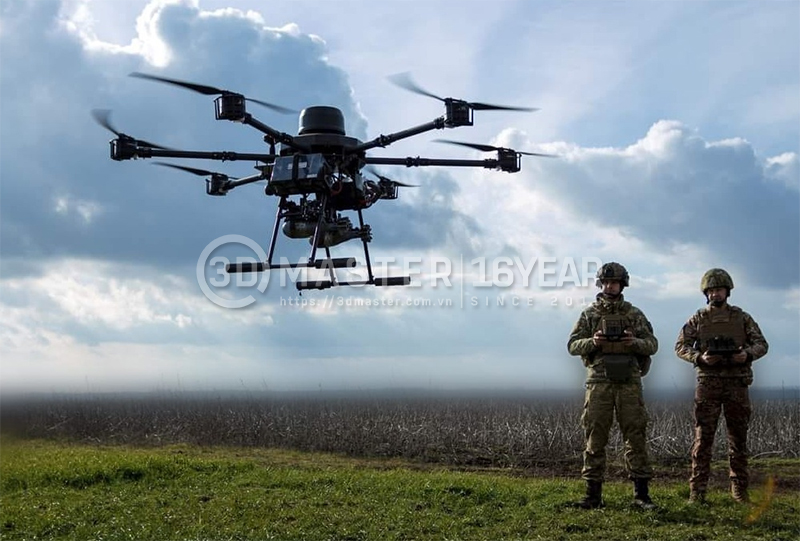
3D scanning technology captures millions of coordinate points across an object's surface within seconds. Using professional systems such as the Creaform HandySCAN EVO, manufacturers can create a highly accurate 1:1 Digital Twin of an actual UAV.
This geometric data provides the foundation that enables AI to understand and analyze the physical structure of the aircraft. Every critical component can be digitally captured, including:
Airframe Scanning: Accurately captures the aerodynamic profile of the fuselage and wings, allowing engineers to identify surface imperfections that may increase air resistance.
Propeller Digitization: Records complex twisted blade geometries with exceptional detail, providing the data needed to improve lift efficiency while reducing operational noise.
Motor Assembly Scanning: Captures cooling fins, shaft positions, and mechanical dimensions to support precise thermal simulation during operation.
Camera Mount and Battery Compartment Inspection: Digitizes structural load-bearing regions and center-of-gravity distribution, enabling AI to calculate the optimal balance for stable flight.
Once comprehensive 3D scan data has been generated, AI begins acting as an intelligent analytical engine that transforms raw geometric information into valuable engineering insights.
AI can:
Analyze the complete UAV geometry
Compare CAD models with manufactured parts
Detect manufacturing deformation
Identify dimensional deviations
Evaluate the impact of design modifications
Recommend optimized design alternatives
Compared with conventional manual measurement methods, 3D scanning offers several advantages:
Non-contact measurement
Ability to capture highly complex freeform surfaces
Measurement accuracy down to a few hundredths of a millimeter (depending on the scanning system)
Collection of millions of 3D data points within minutes
Clean, complete datasets suitable for AI and machine learning applications
With reliable digital data, AI delivers more accurate analyses, reduces engineering errors, shortens development cycles, and helps manufacturers bring UAV products to market faster.
By integrating AI with 3D scanning, UAV research and development becomes significantly faster, smarter, and more accurate.
Instead of relying on repeated physical prototyping, manufacturers can optimize designs directly from digital models.
Benefits include:
Faster processing of 3D scan data
Early detection of design flaws
Lightweight structural optimization
Reduced reverse engineering time
Improved simulation accuracy
Creation of centralized 3D databases for product optimization
Establishment of Digital Twin infrastructure for AI applications
Shorter product development and commercialization cycles
Rather than improving individual tasks, AI and 3D scanning optimize the entire UAV development workflow.
This has become a critical competitive advantage for manufacturers seeking to reduce costs while accelerating innovation.
.jpg)
The combination of AI and 3D digitization is changing every stage of UAV development and maintenance.
Next-Generation UAV Design
AI performs topology optimization to generate lightweight yet highly durable frame structures based on 3D scan data from existing aircraft.
Spare Part Development
Reverse engineering enables rapid reconstruction of discontinued components, competitor parts, and precision mechanical assemblies.
Maintenance, Repair, and Overhaul (MRO)
Periodic 3D inspections allow AI to compare scan results over time and detect hidden cracks or material fatigue before failure occurs.
Automated Production Inspection
During mass production, 3D scanners inspect each UAV while AI automatically evaluates dimensional deviations and rejects defective parts in real time.
To remain competitive, UAV manufacturers should establish the following technological foundations:
Invest in Metrology-Grade 3D Scanning Systems
Deploy high-precision scanners capable of generating reliable measurement data for AI-driven engineering.
Build a Comprehensive 3D Component Library
Digitize every component—from screws and electronic boards to motors—into standardized digital assets.
Standardize Digital Twin Workflows
Implement Digital Twin management throughout the product lifecycle to ensure seamless data integration.
Integrate AI into R&D and Quality Control
Adopt AI-powered inspection software to automate 3D data interpretation and quality assessment.
Train Engineering Teams
Develop expertise in operating professional 3D scanners and applying AI-driven data analysis throughout product development.
Artificial Intelligence is fundamentally transforming how companies design and develop unmanned aerial vehicles. However, AI can only perform effectively when supported by accurate digital data.
3D scanning technology bridges the physical and digital worlds by creating precise geometric datasets that AI can analyze, learn from, and optimize.
If your organization is looking for high-accuracy 3D scanning solutions for UAV design, inspection, or optimization, 3D Master is ready to support your project.
Contact 3D Master today for expert consultation, live equipment demonstrations, and rapid deployment tailored to your manufacturing needs.
3D Master Contact Information
Hotline / Zalo / LINE / Telegram / WhatsApp / Viber / KakaoTalk:
+84 982 089 198 | +84 986 333 960
Email:
Website: