CreatBot PEEK 250 3D Printer – An Alternative to CNC for Complex Geometries
CreatBot PEEK 250 3D Printer – An Alternative to CNC for Complex Geometries
Posted Date: 20-04-2026
CreatBot PEEK 250 3D Printer – An Alternative to CNC for Complex Geometries
Although CNC machining remains the “gold standard” in modern manufacturing, it is increasingly revealing limitations when dealing with highly complex geometries or lightweight optimized hollow structures. As programming time and costs escalate, the CreatBot PEEK 250 3D printer emerges as an effective solution. Not only can it process ultra-performance materials such as PEEK and PEI, but it also enables the realization of “impossible” geometries with optimal cost efficiency.
1. CreatBot PEEK 250 – A Technological Platform Complementing CNC
1.1 Capabilities and Technical Specifications of the CreatBot PEEK-250
CreatBot PEEK 250 is an industrial-grade 3D printer developed by CreatBot (Henan Creatbot Technology Co., Ltd – China), specializing in high-temperature 3D printing solutions for engineering materials.
The machine is designed to process high-performance materials such as PEEK (super engineering plastic), PEI (ULTEM), PEKK, and carbon fiber composites.
Technical specifications of the PEEK 250:
Build volume: 250 × 250 × 300 mm
Technology: FDM/FFF for high-temperature materials
Nozzle temperature: up to 480°C
Heated bed temperature: 200°C
Chamber temperature: 200°C, fully enclosed heated chamber to prevent warping
Extrusion: Direct drive, optimized for engineering-grade polymers
Insulation: Multi-layer structure for stable thermal control
Cooling: Liquid cooling system for high-temperature components
Integration: Printing and post-processing within the same system
Importantly, the CreatBot PEEK 250 belongs to the high-performance industrial 3D printer segment—not a consumer-grade machine—so it is engineered to handle challenging engineering materials and parts requiring high strength and precision in real-world working environments.
CreatBot PEEK 250 3D Printer for complex manufacturing replacement
1.2 Why Can CreatBot PEEK 250 Replace CNC in Certain Cases?
The CreatBot PEEK 250 does not completely replace CNC, but it excels in solving complex geometry and design optimization challenges thanks to the following advantages:
No cutting tool dependency: Layer-by-layer fabrication eliminates tool access limitations
Single-piece production: Eliminates assembly requirements and reduces accumulated errors
High-performance materials processing: Supports PEEK, PEI (ULTEM), PEKK, and engineering polymers with near-metal mechanical properties, high heat resistance, and chemical resistance
Printed parts are not only visually accurate but also strong enough for real-world applications, thanks to advanced thermal management (preventing warping and cracking) and integrated annealing processes directly within the machine.
2. Real-World Applications Where CreatBot PEEK 250 Replaces CNC Effectively
The CreatBot PEEK-250 is particularly effective in manufacturing scenarios where CNC faces limitations in geometry, structure, and design optimization:
Parts with complex internal channels: Used in mold cooling, airflow, or fluid systems where CNC cannot drill or machine internally
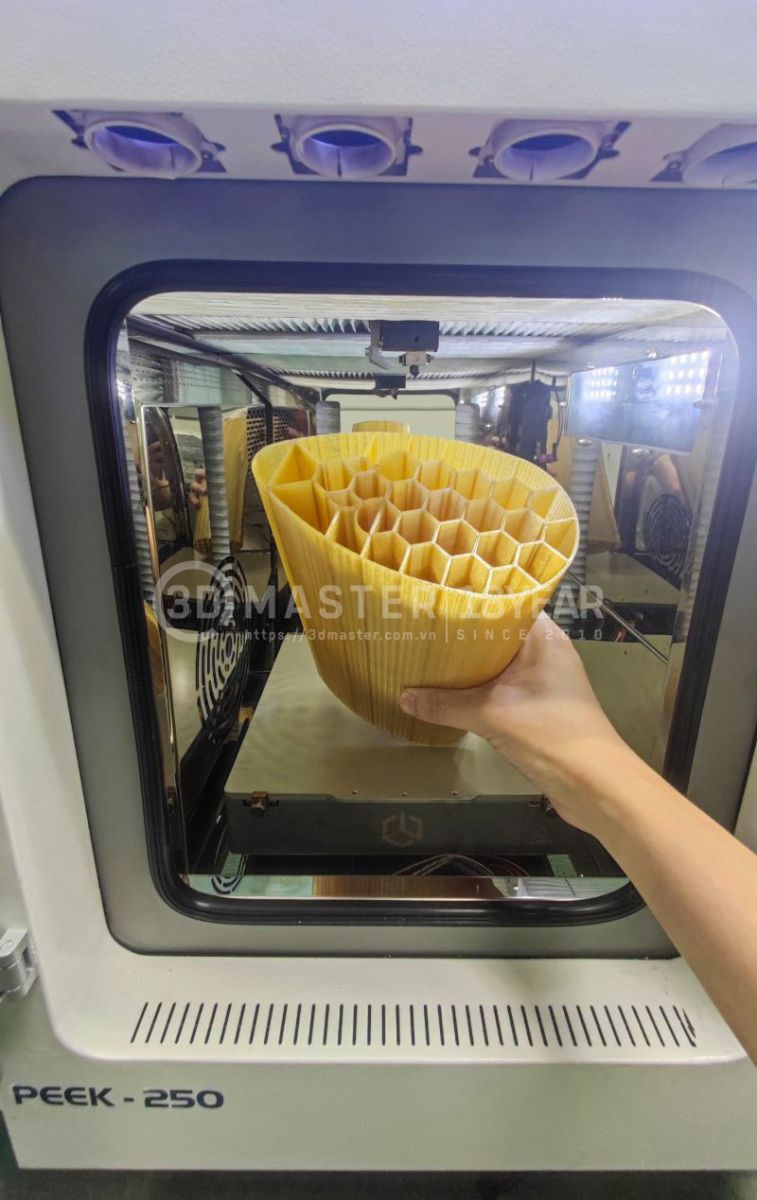
3D lattice or honeycomb structures: Optimize weight reduction while maintaining strength in mechanical and aerospace applications
Part consolidation: Combine multiple CNC components into a single printed unit, reducing assembly errors and production time
Freeform geometries: Ideal for algorithm-driven designs with complex curved shapes beyond traditional machining standards
Thin-walled complex shells: Difficult for cutting tools but easily controlled with layer-based printing
High-temperature and chemical-resistant components: Use PEEK to replace metal in harsh environments
AI-optimized structures: Designed based on load distribution, minimizing material while maintaining structural integrity
Honeycomb structure optimized for weight using PEEK 3D printing
3. Practical Workflow for 3D Printing with CreatBot PEEK-250
Step 1: Design and Data Preparation (DfAM + Material)
This stage focuses on transitioning from traditional machining thinking to design specifically for additive manufacturing, while ensuring material stability before printing.
Apply DfAM (Design for Additive Manufacturing) principles
Optimize geometry to reduce support structures and material waste
Design based on layer-by-layer fabrication for better interlayer bonding and overall strength
Prepare and dry PEEK material to remove moisture and prevent defects
Ensure material stability prior to printing
Step 2: Setup and 3D Printing with CreatBot PEEK-250
This stage ensures stable operating conditions and process control for high-quality output.
Configure parameters suitable for PEEK (nozzle ~480°C, chamber ~200°C)
Preheat the chamber to maintain uniform thermal conditions
Print parts layer by layer according to the programmed design
Continuously monitor the process to detect issues such as delamination, deformation, or poor adhesion
Step 3: Thermal Processing and Quality Inspection
This stage enhances material performance and ensures the part meets technical requirements before actual use.
Perform in-machine annealing to improve mechanical strength and stabilize internal structure
Controlled cooling to reduce residual stress and prevent cracking
Mechanical testing to ensure load-bearing capability
Dimensional inspection to verify accuracy
Surface finishing if needed (grinding, coating) for improved aesthetics and durability
Setup and operation of high-temperature 3D printing systems
4. When Is CreatBot PEEK-250 a Better Choice Than CNC?
Choosing between the CreatBot PEEK-250 and CNC machining depends on geometry complexity, material requirements, and production objectives.
USE CreatBot PEEK-250 when:
Parts have complex geometries difficult for traditional machining
Internal hollow structures or channels are required
Weight optimization is critical while maintaining mechanical strength
Low-volume or custom production is needed
Rapid prototyping is required before mass production
DO NOT use CreatBot PEEK-250 when:
Parts have simple geometries easily machined by CNC at lower cost
Mass production requires minimized cost per unit
Solid metal materials with superior hardness and strength are required
5. Where to Buy Affordable and Reliable 3D Printers? – 3D MASTER
If businesses are researching the CreatBot PEEK 250 price and looking to optimize investment in industrial 3D printing, 3D MASTER Co., Ltd. is a leading partner in Vietnam worth considering.
Key advantages of 3D MASTER:
Official distributor of Creaform for over 10 years in Vietnam
Equipped with full demo systems and experienced technical teams
Supplies genuine industrial 3D printers and 3D scanners with optimized configurations
Provides application-based consulting to avoid incorrect investments
Offers direct technical support during operation and production
Delivers end-to-end solutions: 3D scanning → design → 3D printing → CNC machining
CNC still plays a critical role, but it is no longer the optimal solution for every manufacturing challenge. The CreatBot PEEK 250 3D printer introduces a new approach—where parts are not just machined but created according to engineering logic and real-world application requirements.
???? Optimize production at the lowest cost – Explore 3D printing solutions today!
.jpg)
.jpg)