Choosing the Best 3D Scanner for UAV Manufacturing Today
Choosing the Best 3D Scanner for UAV Manufacturing Today
Posted Date: 22-06-2026
Choosing the Best 3D Scanner for UAV Manufacturing Today
In unmanned aerial vehicle (UAV) manufacturing, the accuracy of every component directly impacts flight performance, stability, and product quality. As a result, manufacturers are increasingly adopting industrial-grade 3D scanning systems for reverse engineering, quality inspection, and next-generation UAV development.
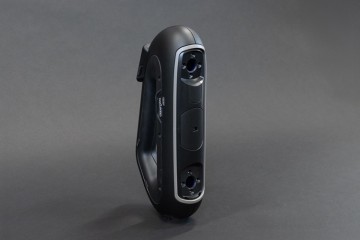
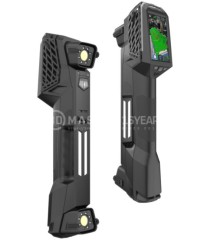
Among the available solutions, the Creaform HandySCAN EVO is highly regarded for its metrology-grade accuracy, operational flexibility, and ability to meet the demanding requirements of the UAV industry.
1. Unique Requirements for 3D Scanning in UAV Manufacturing
The production of unmanned aerial vehicles involves extremely stringent requirements regarding geometric accuracy and 3D data quality.
To support UAV design, manufacturing, and quality inspection processes, a 3D scanning system should meet the following requirements:
Ultra-high accuracy (<0.05 mm): Ensures minimal dimensional deviation for optimal aerodynamic performance and flight stability.
Excellent performance on carbon fiber and composite materials: The scanner must capture dark or light-absorbing UAV surfaces without losing critical data.
High resolution at assembly interfaces: Accurately captures details around motor mounts, propeller shafts, and battery compartments to ensure precise assembly.
Accurate wing profile reconstruction: Captures complex aerodynamic curves required for Computational Fluid Dynamics (CFD) simulations.
High scanning speed: Enables rapid acquisition of large surface areas, minimizing distortion caused by thin composite or plastic structures.
Non-contact measurement technology: Uses laser or blue-light technology to prevent deformation or damage to lightweight UAV components.
Compatibility with reverse engineering workflows: Point-cloud data should be easily converted into STEP or IGES CAD formats for structural optimization and engineering analysis.
2. Why Is the Creaform HandySCAN 3D EVO Suitable for the UAV Industry?
2.1 Metrology-Grade Accuracy for Manufacturing Environments
The Creaform HandySCAN 3D EVO was specifically developed for industrial metrology applications requiring high measurement accuracy.
The system offers accuracy up to 0.020 mm and is certified according to ISO 17025 standards, making it suitable for modern manufacturing quality-control environments.
For UAV applications, this level of precision enables highly reliable inspection of mechanical components, composite structures, and assembly parts.
Another significant advantage is its wireless connection capability. This allows operators to move freely around large UAV assemblies and prototypes without the limitations of cables.
2.2 Dynamic Referencing Technology for Vibration Compensation
One of the most advanced technologies integrated into the Creaform HandySCAN EVO is Dynamic Referencing.
This technology continuously tracks both the scanner and the scanned object through reference targets throughout the scanning process.
In UAV manufacturing facilities, vibrations caused by machining equipment and personnel movement are often unavoidable.
Dynamic Referencing maintains measurement accuracy even under less-than-ideal working conditions.
The technology also improves scan repeatability, which is critical when inspecting multiple UAV components or comparing production batches.
2.3 Rapid Data Acquisition on Complex Aerodynamic Shapes
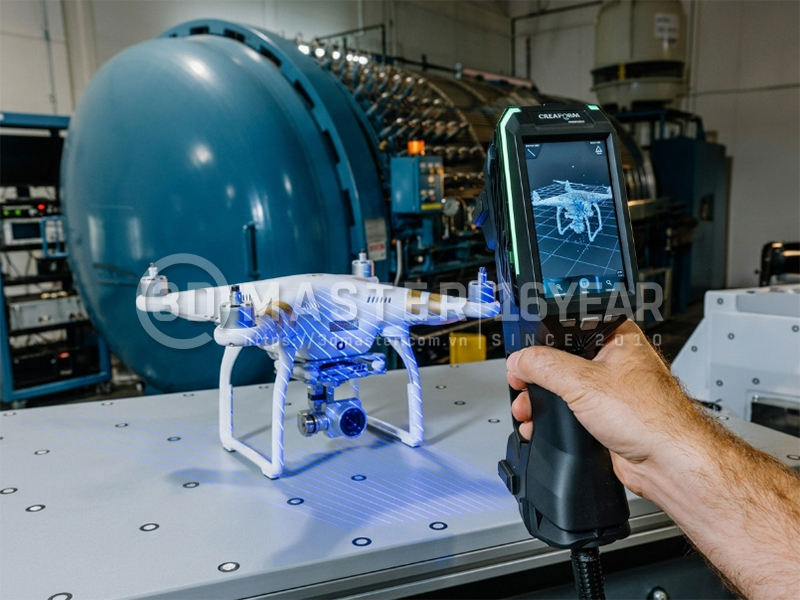
The HandySCAN 3D EVO utilizes a powerful blue-laser system consisting of 46 blue laser crosses plus 16 additional laser lines, enabling rapid data acquisition with high point density.
The system efficiently captures complex curved surfaces commonly found on UAV fuselages, wings, and composite structures.
Blue laser technology performs effectively on a wide variety of materials and can scan many challenging surfaces without extensive preparation.
This capability is particularly valuable when working with carbon-fiber and composite components commonly used in unmanned aviation.
Thanks to its high acquisition speed, manufacturers can significantly reduce product digitization time. CAD reconstruction from existing components also becomes faster, accelerating research and development activities.
HandySCAN 3D EVO Supporting UAV Component Digitization
3. Key Applications of HandySCAN 3D EVO in UAV Manufacturing
The HandySCAN 3D EVO is utilized throughout multiple stages of UAV research, development, and manufacturing.
Reverse Engineering: Scan existing UAV designs and reconstruct accurate 3D CAD files for design improvements, weight reduction, and feature upgrades.
UAV Airframe and Wing Inspection: Compare scan data directly with original CAD models to identify aerodynamic profile deviations.
Mold Inspection: Verify plastic injection molds and carbon-fiber molds to ensure final UAV components meet design specifications.
Assembly Verification and Concentricity Inspection: Measure assembly interfaces, propeller shafts, and motor compartments to ensure perfect mechanical alignment.
Damage Analysis and Maintenance (MRO): Scan dents, cracks, and structural damage after flight testing to evaluate durability and plan repairs.
Simulation Input Generation (FEA/CFD): Provide highly accurate 3D models for finite element analysis and aerodynamic simulations.
4. How Should UAV Manufacturers Implement 3D Scanning for Maximum Efficiency?
To maximize the benefits of 3D scanning, reverse engineering, and quality inspection in UAV production, organizations should adopt the following strategic approach:
Invest in or outsource Creaform HandySCAN EVO scanning solutions: The blue-laser technology is ideal for glossy carbon-fiber surfaces and complex UAV geometries.
Train engineering teams across three core disciplines: Scanner operation, reverse engineering (CAD), and quality inspection should work together as an integrated workflow.
Apply 3D scanning during mold manufacturing: Use color-map analysis to identify dimensional deviations in plastic and composite molds before production begins.
Establish routine inspection procedures for critical assemblies: Regularly verify propeller shaft alignment, battery compartments, and motor mounting positions to minimize vibration during flight.
Develop a Digital Twin library for accelerated R&D: Store scan data from multiple UAV generations to support aerodynamic analysis and future design improvements.
Collaborate with experienced metrology partners under NDA agreements: Leverage external expertise and infrastructure while protecting intellectual property and reducing initial investment costs.
5. Choosing an Experienced UAV Inspection and Digitization Partner – 3D MASTER
For organizations that are not yet ready to invest in equipment or wish to optimize R&D budgets, professional 3D scanning services offer a flexible and cost-effective alternative.
3D MASTER is one of Vietnam's leading providers of 3D measurement and digitization solutions for UAV manufacturing.
Official Creaform distributor for more than 10 years in Vietnam, with access to advanced blue-laser systems such as the HandySCAN EVO.
Extensive expertise in mechanical engineering and aerodynamics: Engineers understand UAV structures and can capture complete data from hidden areas, assembly joints, and wing profiles.
Advanced reverse engineering capabilities: Highly skilled in converting point-cloud data into smooth, high-quality CAD models in STEP and IGES formats.
International-standard inspection workflows: Delivers professional quality-control reports using advanced software such as VXelements.
Fast response and data delivery: Supports rapid product development and manufacturing schedules without disruption.
Strict confidentiality and intellectual property protection: Comprehensive NDA agreements ensure protection of proprietary UAV designs and engineering data.
To improve product quality and reduce development time, UAV manufacturers must adopt highly accurate 3D scanning solutions capable of performing reliably in real-world production environments.
The Creaform HandySCAN 3D EVO delivers exceptional performance for quality inspection, reverse engineering, and manufacturing applications within the UAV industry.
Investing in advanced metrology-grade 3D scanning technology is a critical step toward enhancing competitiveness and accelerating innovation in UAV manufacturing.
>>> Digitize Your UAV with Precision! Register for Professional 3D Scanning Services Today
3dmaster:Nếu anh đang cần tối ưu quy trình hoặc dựng lại dữ liệu CAD từ mẫu thực tế thì bên em sẵn sàng trao đổi thêm để tìm giải pháp phù hợp nhé. 3 tháng trước
Quốc Huy
Độ chính xác của HandySCAN EVO khi quét vật liệu carbon có bị ảnh hưởng nhiều không? Bên mình đang làm drone nông nghiệp
3dmaster:Chào anh Huy, máy scan bên em cho độ chính xác cao và quét tốt trên vật liệu composite, carbon. Bên em sẽ liên hệ anh để trao đổi cụ thể hơn nhé! 3 tháng trước