In the UAV manufacturing industry, composite materials and carbon fiber are increasingly being adopted due to their ability to optimize weight while maintaining exceptional strength. However, these materials also create significant challenges during inspection and digitization using 3D scanning technology.
How can UAV 3D scanning achieve metrology-grade accuracy on these specialized material surfaces? This article provides a detailed analysis of the challenges and the most effective solutions available today.
Composite materials and carbon fiber are advanced engineering materials widely used in aerospace and defense applications because of their outstanding benefits.
Ultra-Lightweight Construction
Compared to traditional materials such as aluminum or steel, composites significantly reduce the overall weight of the equipment.
Exceptional Strength-to-Weight Ratio
Despite being extremely lightweight, carbon fiber structures offer remarkable stiffness as well as outstanding tensile and compressive strength.
Excellent Corrosion Resistance
These materials are highly resistant to oxidation and environmental degradation, even under harsh weather and operating conditions.
Performance Optimization
Reducing airframe weight directly contributes to longer flight endurance and increased payload capacity, allowing UAVs to carry heavier cameras and sensors.
Mastering composite material technology is not simply about reducing weight—it is a critical factor that determines a UAV's competitive advantage in both flight duration and useful payload capacity.
This is why composite materials and carbon fiber have become standard materials in many modern civilian and military UAV platforms.
.jpg)
Thanks to their superior mechanical properties, composite materials are widely used in UAV structures that experience aerodynamic loads and operational stress.
Fuselage
The main body housing batteries, flight control electronics, and communication systems.
UAV Wings
Particularly in fixed-wing UAVs, where complex curved airfoil geometries are required to generate aerodynamic lift.
Multirotor Frames and Arms
Motor support structures that continuously endure vibration loads generated by rotating propellers.
Sensor and Camera Protective Housings
Radomes and gimbal mounting systems that protect specialized surveying equipment such as LiDAR and RTK systems.
High-Performance Propellers
Carbon fiber construction prevents deformation at high rotational speeds and maintains stable thrust generation.
Although these materials provide excellent flight performance, composite and carbon fiber surfaces are often challenging for conventional 3D scanners.
To obtain complete digital data from an unmanned aerial vehicle, UAV 3D scanning processes must overcome several significant technical obstacles.
High Light Absorption
The characteristic black surface of carbon fiber absorbs conventional laser energy, resulting in missing geometric data during scanning.
Non-Uniform Reflection
The combination of glossy and matte composite regions creates extreme light scattering, generating substantial measurement noise.
Complex Geometries
Aerodynamic recesses, deep cavities, and miniature joints found in modern UAV designs are extremely difficult to measure using conventional methods.
Wide Range of Sizes
Inspection systems must accommodate everything from miniature drone components to military UAVs with wingspans measuring several meters.
Environmental Vibrations
Continuous vibration from factory machinery or strong winds at outdoor airfields can significantly affect scan coordinate accuracy.
Small Features and Complex Curved Surfaces
Modern UAVs contain numerous intricate details that require exceptionally high scanning resolution.
In UAV manufacturing, reverse engineering, and quality control processes, digitization accuracy plays a decisive role in project success.
When UAV 3D scan data fails to meet metrology-grade standards, organizations may face serious consequences.
Assembly Errors
Point cloud inaccuracies lead to incorrect CAD reconstruction, causing misalignment of wings, fuselage sections, and motor mounts.
Loss of Part Compatibility
Geometric discrepancies between digital models and physical components create challenges when upgrading or manufacturing replacement parts.
Undetected Defects
Micro-cracks, shell twisting, and motor-axis deviations formed during composite manufacturing may remain unnoticed if scanner resolution is insufficient.
Incorrect Color Maps
Inspection software may generate inaccurate deviation analyses, leading engineers to mistakenly reject good parts or approve defective ones.
Increased Aerodynamic Drag
Even a few millimeters of deviation in an airfoil profile can alter airflow behavior and create asymmetric drag forces.
Reduced Battery Life and Payload Capacity
Motors must compensate for aerodynamic imbalance, increasing power consumption and reducing available payload.
Risk of UAV Failure
A twisted UAV structure can shift the aircraft’s center of gravity and increase the likelihood of sudden instability or crashes.
Waste of High-Value Materials
Late defect detection after composite curing often forces manufacturers to scrap expensive carbon fiber components.
Project Delays
Repeated mold modifications and testing cycles caused by inaccurate scan data can significantly extend product development timelines.
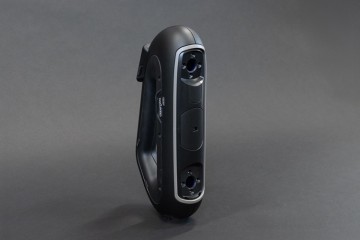
Creaform HandySCAN EVO enables efficient scanning of carbon fiber and composite surfaces.
To overcome the unique challenges associated with composite materials, the Creaform HandySCAN EVO handheld blue laser 3D scanner provides an ideal technological solution.
Optimized for Carbon Fiber Surfaces
Featuring 46 laser lines combined with 16 additional high-density laser lines, HandySCAN EVO captures data efficiently on dark, glossy carbon fiber surfaces without requiring spray coating.
Metrology-Grade Accuracy
The system delivers accuracy up to 0.020 mm and point-cloud resolution of 0.025 mm, meeting stringent international standards such as ISO 17025, IATF 16949, and ISO 10360.
Scanning Complex Geometries
With a scanning speed of up to 2,800,000 measurements per second, the scanner captures complete data from wing cavities, sensor mounts, and aerodynamic recesses without blind spots.
Dynamic Referencing Technology
Integrated Dynamic Referencing automatically compensates for environmental vibrations, ensuring highly accurate UAV 3D scan data even in demanding industrial environments.
Unlimited Measurement Volume
The system can seamlessly inspect everything from miniature mechanical components to large agricultural and military UAVs with multi-meter wingspans.
High Mobility in Field Conditions
Weighing only 1.04 kg and offering flexible wireless connectivity, HandySCAN EVO can be transported directly to airfields and maintenance facilities for on-site inspection.
To ensure product quality, optimize design processes, and shorten development cycles, organizations need a UAV 3D scanning solution capable of handling complex carbon fiber and composite surfaces effectively.
With its blue laser technology, metrology-grade accuracy, and exceptional portability, Creaform HandySCAN EVO is an ideal solution for UAV manufacturing, quality inspection, and reverse engineering applications.
If your organization is looking for a professional UAV 3D scanning solution, contact 3D MASTER for expert consultation. With more than 10 years of experience as an official Creaform distributor in Vietnam, 3D MASTER provides equipment, technical support, and tailored 3D measurement solutions for businesses.
Hotline / Zalo / LINE / Telegram / WhatsApp / Viber / Kakaotalk: +84 982 089 198 | 0986333960
Email:
cuong3dmaster@gmail.com
hung3dmaster@gmail.com
tech3dmaster@gmail.com
Website: https://3dmaster.com.vn