Unmanned Aerial Vehicles (UAVs) are widely used in military operations, agriculture, topographic surveying, logistics, and industrial inspection. To meet increasing demands for flight performance, precision, and faster product development, UAV manufacturers are increasingly adopting 3D scanning technology.
This technology enables rapid digitization of complex components, supporting design, quality inspection, and manufacturing optimization. Today, 3D scanning is considered one of the key technologies in modern UAV production.
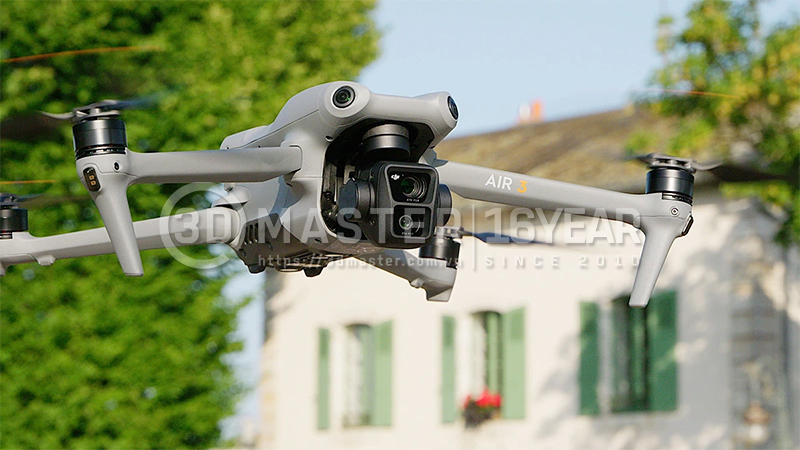
An Unmanned Aerial Vehicle (UAV) is an aircraft operated remotely or autonomously without a pilot onboard.
To understand why 3D scanning is becoming increasingly important in UAV manufacturing, it is essential to consider the unique technical requirements of UAV systems:
3D scanning enables fast and accurate acquisition of geometric data, creating complete digital models for design, inspection, and product optimization throughout the UAV lifecycle.
Thanks to these advantages, 3D scanning has become a critical technology for improving product quality, shortening development time, and enhancing competitiveness in the UAV industry.
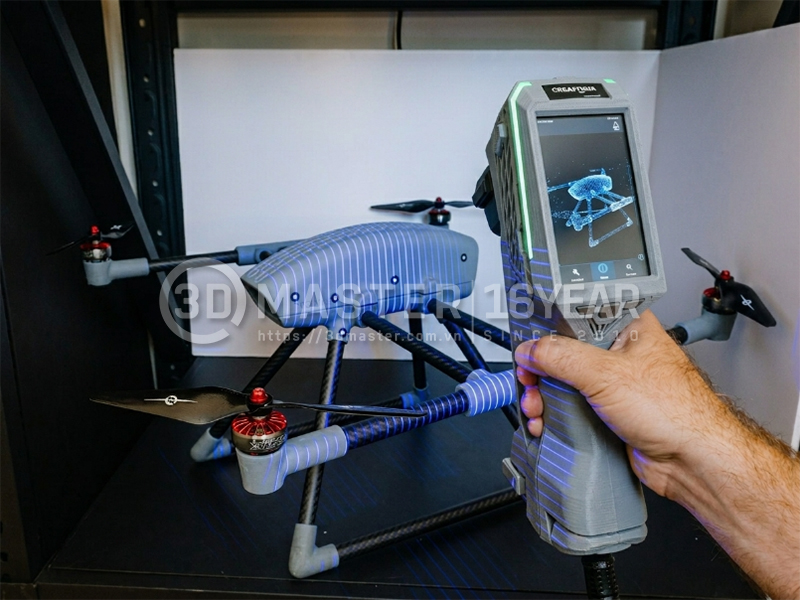
Reverse engineering is one of the most common applications of 3D scanning in UAV manufacturing.
Many companies choose the Creaform HandySCAN EVO because of its wireless operation, ability to accurately scan complex curved surfaces and composite materials, and capability to capture 3D data directly on the production floor.
After scanning, the data can be converted into CAD models for various purposes:
As a result, manufacturers can significantly reduce design time, minimize manual measurements, and improve development accuracy.
Accuracy is a key factor determining UAV quality and performance.
With 3D scanning, manufacturers can quickly scan and compare physical components against CAD models to identify deviations early in the production process instead of waiting until final assembly.
Typical applications include:
For these tasks, the Creaform HandySCAN EVO helps manufacturers improve product quality and significantly reduce defect rates during UAV production.
Flight performance largely depends on the shape of the fuselage, wings, and propellers.
Using the Creaform HandySCAN EVO, engineers can accurately digitize these components for aerodynamic analysis and design validation.
Common applications include:
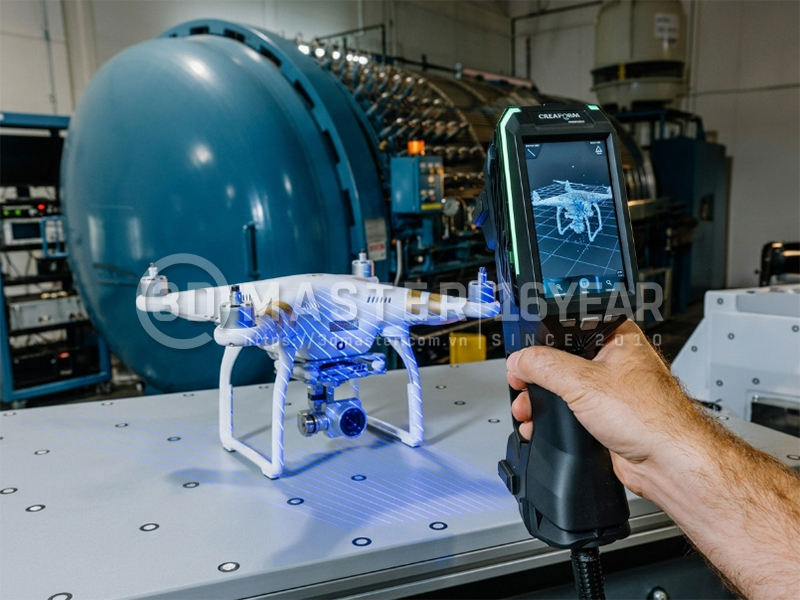
To maximize the value of 3D scanning in UAV manufacturing, the process involves more than simply scanning and generating a 3D model.
The entire workflow must ensure sufficient accuracy for reverse engineering, quality inspection, and product optimization.
Step 1: Scan the entire UAV structure, including the fuselage, wings, frame, or target components to capture precise geometric information, including curved and complex surfaces.
Step 2: Clean the point cloud data, optimize the mesh, and reconstruct a complete 3D model that accurately reflects the actual geometry of the product.
Step 3: Convert the 3D scan data into CAD models for reverse engineering, structural modifications, or development of new UAV versions.
Step 4: Compare the scanned data with engineering drawings or CAD models to evaluate dimensional deviations, assembly tolerances, and manufacturing quality.
Step 5: Use the analysis results to improve designs, refine products, and export data for CNC machining, 3D printing, or mass production.
This workflow is widely adopted by UAV manufacturers and professional 3D scanning service providers such as 3D Master to shorten development cycles while improving accuracy throughout the UAV production lifecycle.
To fully leverage 3D scanning technology in UAV manufacturing, companies need not only advanced equipment but also experienced specialists in 3D metrology, reverse engineering, and quality inspection.
This is especially important for UAV projects, where components often feature complex geometries, strict accuracy requirements, and advanced data processing needs.
When selecting a UAV 3D scanning service provider, manufacturers should prioritize companies that:
3D Master is the official distributor of Creaform 3D scanning solutions in Vietnam, with more than 10 years of experience. The company offers a complete range of advanced scanning systems, particularly the Creaform HandySCAN EVO, available for live demonstrations on real products, supported by a highly experienced team of Scan 3D and industrial quality inspection engineers.
With these capabilities, 3D Master helps UAV manufacturers accelerate product digitization, reverse engineering, tolerance inspection, and product development optimization from R&D through production.
Hotline / Zalo / LINE / Telegram / WhatsApp / Viber / Kakaotalk:
+84 982 089 198 | 0986333960
Email:
cuong3dmaster@gmail.com
hung3dmaster@gmail.com
tech3dmaster@gmail.com
Website: https://3dmaster.com.vn