3D scanning is increasingly widely used in geometric measurement, reverse engineering, and industrial product improvement. However, when deploying 3D scanning in vibrating environments such as operating factories, construction sites, or areas with continuously operating mechanical equipment, many engineers ask a crucial question: can 3D scanning in these conditions ensure accuracy?
This is not only a matter related to equipment, but also directly affects data quality, usability for reverse engineering, and the overall efficiency of the engineering project.
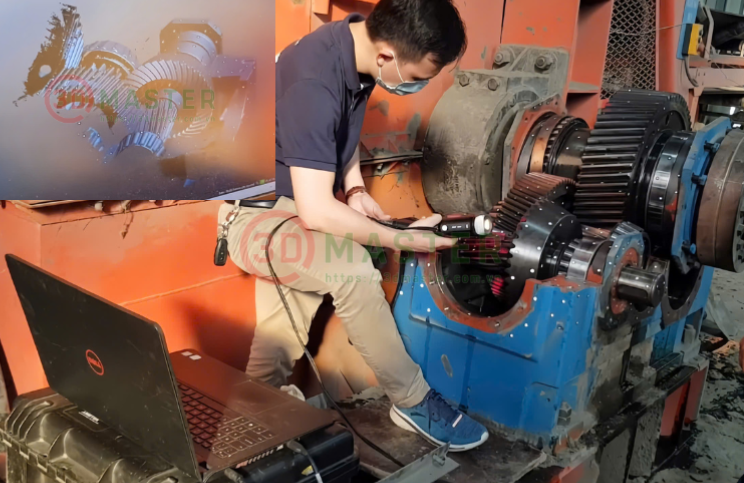
3D scanning in a vibrating environment is the process of collecting geometric data of an object when mechanical vibrations from machinery, floors, steel structures, or the movement of people and equipment are present. These vibrations can be continuous or intermittent, with small amplitudes but high frequencies, significantly affecting the measurement process if not properly controlled.
Unlike 3D scanning in a measurement room or static environment, field 3D scanning requires specialized technology and procedures to ensure that the data obtained remains stable and accurate.
Essentially, 3D scanning is the process of recording the spatial position of millions of measurement points in real time. When vibrations occur, the relative relationship between the scanner head, the object, and the spatial coordinate system can change continuously. This leads to measurement point deviations, data drift, or loss of uniformity across the entire model.
In traditional 3D scanning systems or stationary equipment, vibrations often significantly reduce accuracy, especially with large parts or those requiring tight tolerances. However, with modern 3D scanning technologies designed for industrial environments, vibration is no longer an absolute barrier if handled correctly.
Errors in field 3D scanning don't just come from vibrations alone; they arise from a combination of factors. These could include ground vibrations from machinery, structural floor vibrations, changes in operator posture, or incorrect spatial tracking methods.
Furthermore, failing to clearly define the output objective from the outset is a common reason why 3D scan data, while complete in image quality, may not meet the technical requirements for measurement or reverse engineering. In such cases, vibration only serves to highlight the limitations in the implementation process.
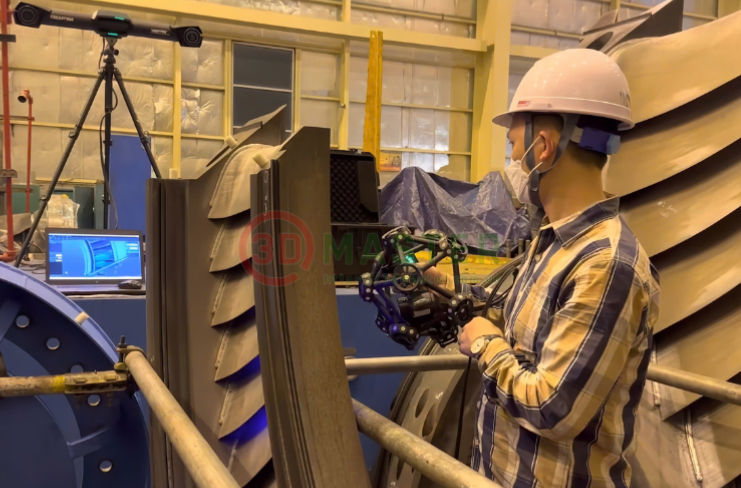
In real-world production, stopping machines or disassembling equipment to move it into a measurement room is impractical for many businesses. This is why on-site 3D scanning is becoming increasingly essential.
With new generation handheld 3D scanning systems, working directly in a vibrating environment is entirely possible. Thanks to dynamic tracking and real-time error compensation, 3D scan data maintains stable accuracy even when the surrounding environment is not completely static.
The key to accurate 3D scanning in a vibrating environment lies in spatial tracking technology and real-time data processing capabilities. High-end handheld 3D scanning systems use non-contact laser technology combined with dynamic tracking algorithms, allowing the system to automatically detect and compensate for small movements during scanning.
Thanks to this, the data obtained is not entirely dependent on the static state of the object or the surrounding environment. This is a key difference between advanced industrial 3D scanning solutions and simple demonstration or measurement scanning devices.
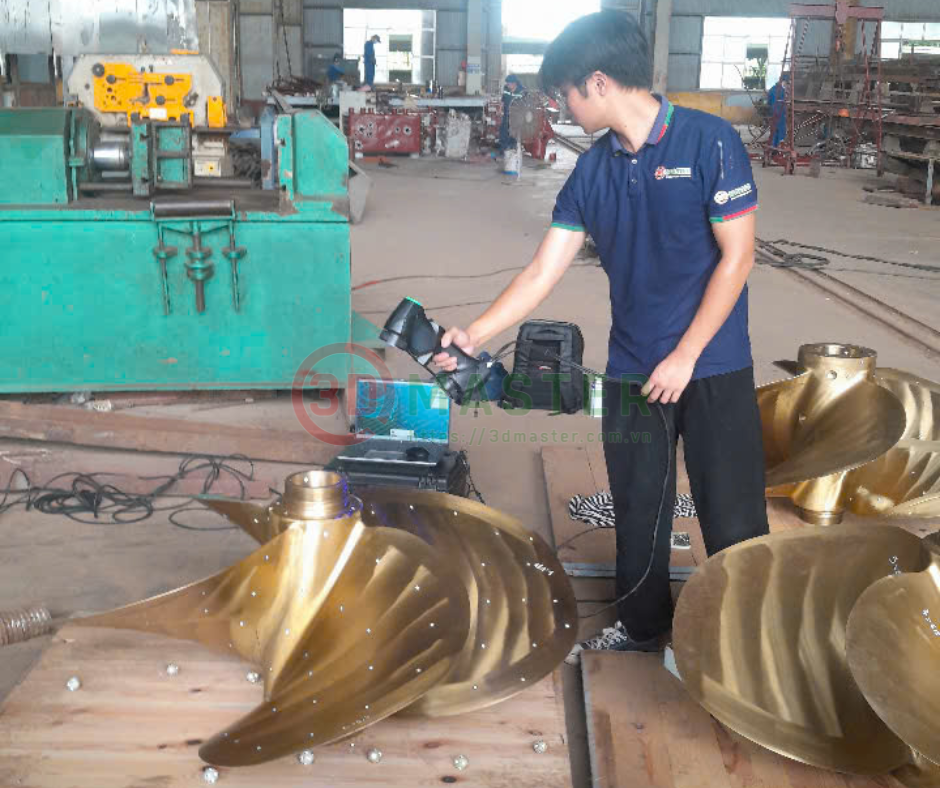
At 3D Master, 3D scanning is not approached as a single data acquisition operation but as a comprehensive engineering solution. Before each field 3D scanning project, 3D Master's engineering team carefully assesses the level of vibration, working conditions, and output requirements to develop a suitable measurement plan from the outset.
3D Master uses genuine Creaform handheld 3D scanners, with high accuracy down to the micrometer level, specifically designed for industrial and vibrating field environments. Dynamic tracking and self-compensation technology ensure that 3D scan data remains stable and consistent across the entire model, even with large details or complex geometries.
With extensive experience in implementing numerous 3D scanning projects in factories, construction sites, and real-world production environments, 3D Master ensures that the 3D scan data obtained can be used directly for measurement, reverse engineering, and engineering analysis without complex manual adjustments.
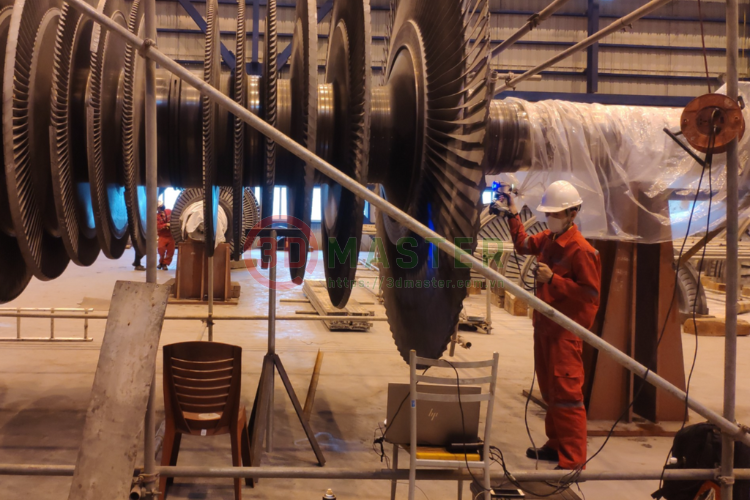
Handheld 3D scanners are the optimal choice when direct 3D scanning is required on-site, especially in environments with vibrations, limited space, or where the object cannot be moved. With their flexibility, mobility, and high accuracy, handheld 3D scanners allow engineers to access the entire geometry of the object without being limited by installation location or size.
In equipment modification projects, part restoration, assembly error checking, or reverse engineering when original drawings are unavailable, handheld 3D scanners offer a clear advantage over traditional measurement methods or fixed scanning systems.
3D scanning in vibrating environments can achieve high accuracy if implemented with the right technology and technical procedures. Instead of viewing vibration as a barrier, engineers and businesses need to choose a 3D scanning solution that suits the field conditions and data usage objectives.
With the Creaform handheld 3D scanner system with micrometer accuracy and practical experience in vibrating industrial environments, 3D Master provides a stable, reliable 3D scanning solution ready to serve measurement, reverse engineering, and manufacturing.
Contact 3D Master for advice on 3D scanning solutions in vibrating environments that are suitable for your project and specific conditions.
See also: Professional, accurate, and efficient 3D digitization services at 3D Master
Hotline - Zalo - LINE - Telegram - WhatsApp - Viber - Kakaotalk: +84 982 089 198 | 0986333960
Email: cuong3dmaster@gmail.com | hung3dmaster@gmail.com | tech3dmaster@gmail.com
Website: https://3dmaster.com.vn
