3D scanning technology enables precise measurement of large-scale mining equipment in harsh environments. This article analyzes how businesses use 3D scanners to collect accurate geometric data for wear inspection, repair, and assembly of heavy industrial equipment.
Divija Technologies was founded in 2003 in Chennai, India, with the goal of providing precise measurement and engineering solutions for various industries. The company quickly built a reputation in areas such as reverse engineering, 3D laser scanning, CMM inspection, and product surface analysis.
Over the years, Divija Technologies' engineering team has participated in numerous complex projects, from factory welding lines and large industrial systems to vehicle digitization projects. Measuring entire metro trains or digitizing washing machine components for production line redesign has helped them accumulate practical experience in challenging engineering environments.
These projects have laid the foundation for the engineering team to handle complex measurement problems requiring high accuracy and tight deadlines.
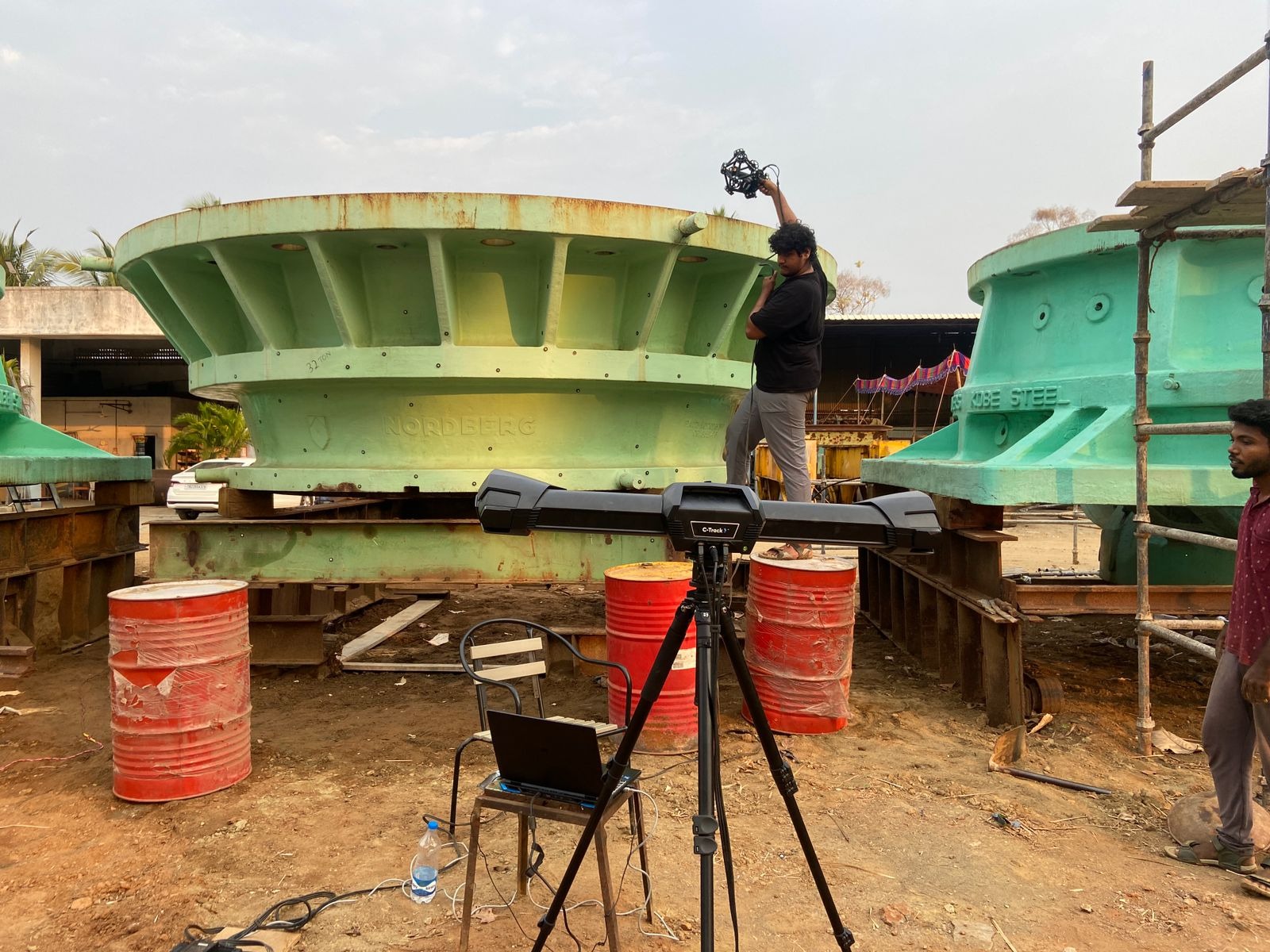
One particular project involved the Thriveni mining company requesting 3D measurements of extremely large mining equipment components at their Salem plant. The goal was to collect accurate geometric data to assess wear levels, prepare repair plans, and ensure accurate reassembly of the equipment.
The parts to be measured had diameters up to six meters. Many components had curved surfaces, deep cavities, and complex structures, making access and measurement very difficult.
Furthermore, the entire measurement process must be performed outdoors. There is no temperature-controlled environment, stable floor, or protective roof. Intense sunlight, dust, and constantly changing weather conditions become major obstacles to collecting accurate measurement data.
Direct sunlight particularly affects the tracking capabilities of optical measurement systems. If the system cannot maintain stable tracking, the entire scanning process will be interrupted.
Besides harsh environmental conditions, the shape of the parts also presents a significant challenge.
Many surfaces are located deep within cavities or behind curved structures, making access difficult. Some locations have large inclinations, making it unfavorable to position the measuring equipment and collect data.
The customer also required measurement data to cover the entire surface of the part, including the interior and small cavities. This means that every geometric detail, however small, must be fully recorded during the scanning process.
Another difficulty relates to the use of reflective targets. With older scanning systems, measuring large details required attaching thousands of targets to the surface. In hot, dusty, and rusty environments, the targets easily fall off, interrupting the measurement data or requiring the process to be restarted.
To ensure a stable scanning process, the technical team had to adjust the work schedule according to lighting conditions.
Work typically started at four in the morning and continued until the sunlight became too strong. Then, the scanning process resumed in the evening when the light was softer.
In addition, engineers also divided the surface of the detail into many small areas for sequential measurement. This approach allows them to easily maneuver around curved areas, deep recesses, or hard-to-reach locations while maintaining stable tracking capabilities of the measurement system.
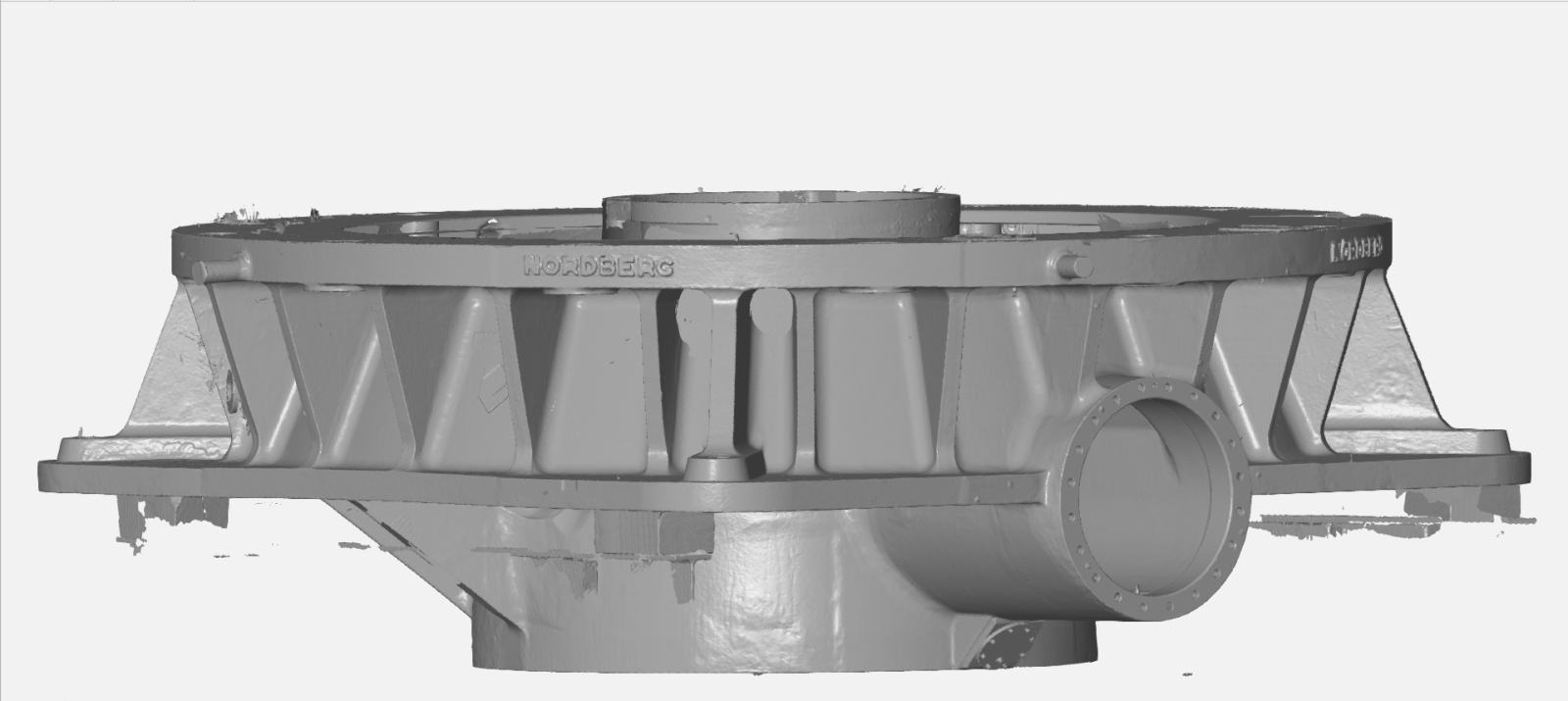
The use of the MetraSCAN BLACK+ Elite 3D scanner along with Inspection software has brought about a major change for the project.
This scanner is designed as a high-speed optical CMM system capable of accurate measurements in a variety of environmental conditions. This technology allows for metrology-grade geometric measurements even in production or outdoor environments.
The ability to scan thin surfaces, complex geometries, and discontinuous areas allows the engineering team to collect data without the complex preparation required previously. The system also allows for the measurement of thin metal areas as little as three millimeters while maintaining high accuracy.
Thanks to the large measurement area, enormous details can be scanned without having to constantly adjust the position of the measurement system.
Throughout the deployment process, the scanning system maintained stable operation even when working on uneven ground or in unfavorable weather conditions.
Even when rain made the ground muddy, the device was still able to collect measurement data stably. The Inspection software processed large datasets of 20 to 30 GB without errors or interruptions.
This level of stability was unprecedented for the technical team with older measurement equipment.
When the project was completed, the efficiency of the 3D scanning solution became very clear.
Using previous measurement systems, the project could have lasted up to twelve days. However, with modern 3D scanning technology, the entire job was completed in just five days.
The number of targets used was also significantly reduced. Instead of having to attach approximately four thousand targets, the engineering team only needed to use forty magnetic targets and could even reuse them during equipment relocation.
Thanks to completing the project ahead of schedule, the engineering team's accommodation and operating costs were also significantly reduced.
Previously, any part larger than two meters caused the engineering team concern about preparation time and measurement stability.
After this project, the approach completely changed. Instead of focusing on how to scan large parts, they could focus on completing the work more quickly and efficiently.
Simply placing the part within the system's measurement range, scanning could begin immediately.
The Salem project demonstrated that 3D measurement of large industrial equipment is entirely feasible even in harsh environments.
The combination of our technical team's field experience and high-precision 3D scanning technology has helped shorten measurement time, simplify processes, and enhance data reliability.
For businesses in the mining and heavy industry sectors, 3D scanning technology is becoming a crucial tool for assessing equipment wear and tear, planning repairs, and optimizing future maintenance processes.
Hotline - Zalo - LINE - Telegram - WhatsApp - Viber - Kakaotalk: +84 982 089 198 | 0986333960
Email: cuong3dmaster@gmail.com | hung3dmaster@gmail.com | tech3dmaster@gmail.com
Website: https://3dmaster.com.vn
